Showing posts with label post-modern world. Show all posts

Sunday, June 8, 2014

Reading up: The Idolatry of God by Peter Rollins

What's unique about The Idolatry of God: Breaking our Addition to Certainty and Satisfaction is that it's not a book for pastors, for preachers, for people who are thinking about preaching, or for church leadership (though any of them would get something out of the read). Rather, it's written in a way that the average unchurched or nominally-churched person could read it. The content is good, but what I'm interested in is how Peter Rollins puts the thing together.

Rollins is a great storyteller, and it's through storytelling that he illustrates some pretty dense theological material in a way that is understandable to people whose only experience of theology is through popular culture or the Christians who make it on the news. What I think is important about how Rollins writes is that it isn't dumbed down--he uses theological language, latin phrases, deep philosophical concepts, and theoretical ways of exploring ideas that aren't pedantic or pandering. I think this is the biggest fault of many church leaders seeking to reach a biblically illiterate generation--they speak and preach as though this illiteracy is actually infancy rather than taking the wealth of experience and theologizing the individual has likely done on her own before a religious professional even walked in the room.

Rollins incorporates stories in ways that layer upon each other, so that he's drawing you into a comfortable textual world in which you he introduces you to stories, then points out their relationship to the faith world. In discussing idolatry, he refers to "the MacGuffin," a term used in film making to discuss the item everyone's after, the magnet of the film, so to speak. In a chapter on self and identity, he uses a Miami Vice episode to explore the concept. And the conclusion is a sketch of a poor but whole woman who works miracles, raises suspicions of the authorities, and brings a renewed sense of peace to those she encounters (sound familiar?).

Though the use of popular culture is often taken as good "illustrations" for sermons, it's rare to see them used to such excellent effect as Rollins does. He's not using them to look cool (I mean, Miami Vice?). He's not using them in a way that sounds inauthentic. Rather, he's using them because they are vehicles that make his point in ways that are easily understandable and don't depend on an entirely new theological vocabulary to engage. They take the stuff of theology and make it accessible, make it so it seems like something that actually happens in real life.

The book itself is more a theology book than preaching text, but I do think that the way Rollins puts together the work is worth taking note of. First of all, he takes pop culture seriously as a story-telling medium that can convey meaningful information. He doesn't appropriate it simply to be hip and with it. Instead, he fleshes out the vehicles in ways that are legitimately helpful. (I had never seen an episode of Miami Vice and yet found his explanation quite compelling and easy to follow.) 

So...it's got me back on my line of thought about language. Rollins spends much of the text redefining, nuancing, and massaging some hefty theological terms. But he doesn't do it in biblical terms, theological terms, or in terms related to church history. Instead, he's focused on stories. And stories that people will be literate to. I think this in itself is an important notion in my developing understanding of vocabulary for preaching--that stories matter more than the language does, in many cases. Perhaps it's a Brueggemann case after all, with the contents being more important than the vessel.


Saturday, June 7, 2014

Reading Up: Preaching at the Crossroads by David J. Lose

Ok. I was hard on poor David Lose in my earlier post. Really hard. Like, perhaps unfairly hard. Because in Preaching at the Crossroads: How the World--and Our Preaching--Is Changing, the man does an admirable job of conveying the landscape of our current context for folks in the pews. And it made me feel like he maybe would have actually understood what it felt like to walk into a giant church full of pastors as a most-of-my-life unchurched person. Maybe he would understand my frustration, disappointment, and inability to understand how the church as it is now has been incapable of conveying the Word to so, so many of my peers. It makes me sad. It makes me angry. It makes me want to work insanely hard. And it makes me want to work with fellow clergy who want to learn a new way, too.

For me, Lose gave me many words for things that I wasn't sure how to express about the state of preaching in the post-Christian, Western society. While I've been living and breathing this context for my entire life, and then studying it intensively in my amazing progressive seminary, I realized that many working pastors may not have a real grasp on the implications of postmodernity, secularism, and pluralism in the everyday lives of their congregants (and potential congregants). Lose spends three chapters unpacking each of these terms, and then a subsequent three chapters providing practical advice for preachers who want to engage these concepts in real ways in sermon preparation, planning, and delivery.

One thing that I do want to touch on is the way he discussed the idea of biblical fluency. I noted my concerns with Willimon's work and with Barbara Brown Taylor's remarks about biblical language, and how I'm generally uncomfortable with biblical language itself being considered normative for Christians. There is something about that idea of teaching an entirely new vocabulary that has the ring of shibboleth to it. But Lose, in a parenthetical, nearly toss-off moment says that he believes Christian churches need to promote biblical fluency, or "the ability to think--without thinking--in the target language." In this way, I understand biblical fluency not to be about vocabulary, but sight. Not flashcards, but paradigm. And that's something that I don't think language is capable of doing.

Though I didn't feel like Lose was saying anything radically different than many of the folks I've been reading or that I heard at the Festival said, he did so in a way that was pastoral and clear. And in this way, it helped me to understand that in many ways, many of the clergy who I am so frustrated with are just not quite equipped yet to deal with the tasks at hand. Or, they feel like they need a prescription for success. At the end of Lose's work, like so many works on preaching right now, he acknowledges that he hasn't offered something more concrete for the preacher to put into action (though I think he does put some excellent concrete ideas out there). But he doesn't apologize for it. Rather, he seems to be excited about the adventure of rediscovering what preaching might mean here and now and in the future. And that made me excited about it. Actually, it made me excited about what I might have to contribute to the conversation myself. So, yeah. Nicely done, David Lose.

Some choice quotes:


  • "If we are called to proclaim good news that is not just old news or the daily news but regularly surprises and even arrests our hearers, then perhaps preachers should not be surprised by the inherent and unending challenge of doing that" (3).
  • "Does Scripture...have nothing more to say to us than what we have already heard and perceived?" (39).
  • "...we preachers do not come to Scripture without a set of questions influenced by our context and experience. And we should not, as our questions are what bring us to the text in the first place. At the same time, by admitting that our context and experience powerfully shape not only our questions for Scripture but also our expectations of Scripture, we make room for others--including the voices within the Scriptures--to call into question our questions, both keeping us honest and keeping a vibrant conversation going" (41). 
  • "In this way, the preacher comes not as the trained expert designated to give a guided tour of an ancient text--let alone perform a postmortem on a dead confession of faith--but rather as an experienced guide and host who makes claims, suggests lively interpretations, makes a wager about the present-day meaning and interpretation of a passage, and ultimately invites the hearer not just to take these claims and confessions seriously but also to respond to them in word and deed" (45). 
  • "...we have unintentionally affirmed the secular impulse to restrict God's activity and therefore have made it increasingly difficult for our people to imagine being 'called' in their daily lives in the secular world. In particular, we have so greatly stressed the importance of Sunday activities that we have unintentionally devalued the lives we lead during the rest of the week" (69).
  • "Visit your people in their vocational arenas, and describe those visits in your preaching...Perhaps it's we who feel odd or out of place in the public venues of our people's lives, at least when we come as a pastor" (73).
  • "Over time, through this and other practices your congregation may grow from being a place where the word is preached more fully into a community of the word where all the members take some responsibility for sharing the good news of God's ongoing work to love, bless, and save the world" (77).
  • "Increasingly, researchers suggest that in a world saturated by meaning-making stories, the mainline church has failed to offer a compelling and central narrative identity that not only informs but also guides the lives of their congregants by providing a resilient religious identity" (100).
  • "Preaching from this framework, is equal measures (1) teaching of the basic worldview and how to apply it to life and (2) exhortation to do so" (103).

Wednesday, June 4, 2014

Reading Up: Crazy Christians: A Call to Follow Jesus by Michael B. Curry

The sermon out of which Michael B. Curry's book Crazy Christians: A Call to Follow Jesus came is the first chapter of his book, but it is also still available to be viewed online. It's a pretty tight sermon, and the book is just as tight. Curry refers to each chapter of the book as an essay in the preface, but it's also easy to read them as sermons (I'm guessing that's where they originated from), and so that's what I did.

The content of each of these messages is thoughtful, clear, connected both to the biblical text and to our current times. Curry is adept at pulling examples of Christian discipleship from historical figures and regular folks he has met on his journey. They have the rhythm and cadence of well-paced sermons, even when read silently (though in her forward, Rev. Dr. Katharine Jefferts Schori encourages us to read them aloud). When I have more time, I'd like to break down the construction of these messages a bit more to get at their flow, but for now, I just want to share some brief thoughts.

One thing that stood out for me is that the essay/sermons in this book often seemed to parallel the biblical text rather than have them at its center. Oftentimes, by the end of the chapter, I had to go back to the beginning to see what passage Curry had begun with to jog my memory. Though each sermon is not centered around the biblical text at hand does not mean that the text doesn't speak. Rather, Curry is never far from the text when he is creating tableaus and scenes from contemporary or historical or even other biblical cultures to illustrate the heart of the message. For me, it was helpful to see how Curry's sermons were soaked in the biblical text while also not feeling like they were a dull exegetical foray. Curry seemed mostly to be preaching on a biblical theme that he rooted in our own context with contemporary images and characters. In many cases, the connection with the text was often one word: "Crazy" in Chapter 1--"We Need Some Crazy Christians," "Something Greater" in Chapter 2--"We Are Part of Something Greater Than Ourselves," "Feet" in Chapter 3--"Following Jesus with Our Feet," and so on. It did not come of as gimmicky at all, but rather served as the hand hold that allowed him to straddle the divide between the text and today's context.

As I was reading, I kept wanting to hear a conversation between he and Walter Brueggemann regarding prophetic imagination. Curry's sermons seem to be dealing with the world and present circumstances in ways the Brueggemann would approve of--especially his message on what the true meaning of "gospel welcome" would be (see "The Gospel Witness of Welcome will Rearrange the World"). He writes, "We never know what can happen when we feel called to follow Jesus' gospel witness of welcome. Heeding such a call can require incredible courage. Sometimes this gospel way of welcome can lead us to put our very lives on the line. But Jesus' way of welcome can inspire us to keep working to do what is right in a world where too often too much is wrong" (113). And the move he makes of imagining the Galilee where Jesus will meet his disciples as today's global context: "We are, all of us, in Galilee" (128).

This is a book I will likely revisit soon, not only to do a little deeper digging into the sermons to understand their construction, but also for inspiration for how to preach in ways that are faithful to both the biblical text and our times.

Tuesday, June 3, 2014

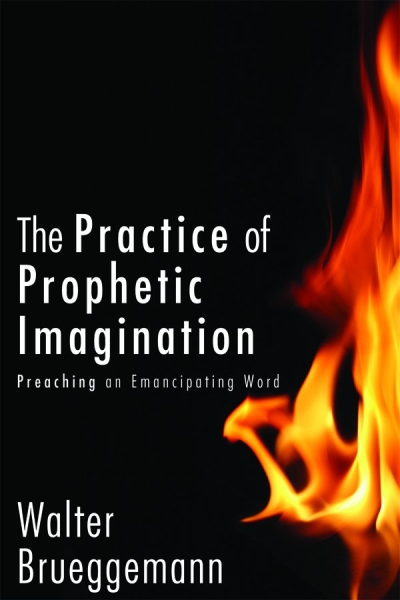
Reading Up: The Practice of Prophetic Imagination by Walter Brueggemann

Thank God. No, really. Thank. God.

Do you want to know how to begin to think about preaching to a post-modern assembly? Then read this book.

I kept putting off reading The Practice of Prophetic Imagination for a while. I don't know why. It felt intimidating. It felt overwhelming. It felt dense. And it was all of those things. But at the same time, I felt like Brueggemann (as usual) was saying things that needed to be said, setting an agenda that needed to be set, proclaiming the Word boldly. At the end of each chapter, I briefly considered giving Brueggemann a standing ovation. Then I thought my dog might think it was for her, and we don't want her getting a big head.

"Prophetic proclamation is an attempt to imagine the world as though YHWH--the creator of the world, the deliverer of Israel, the Father of our Lord Jesus Christ whom we Christians come to name as Father, Son, and Spirit--were a real character and an effective agent in the world" (2).

It sounds simple. It sounds obvious. But as Brueggemann takes the reader on a complete tour of the prophetic biblical canon, one sees how the obvious is over and over and over again occluded by the dominant culture. Brueggemann identifies our time as one caught up in "conventional idolatries and/or conventional atheisms," thus meaning that the preaching task is one that requires courage, imagination, and risky. Sign me up.

Brueggemann brilliantly and succinctly sums up the context of twenty-first century American context as being a strange mix of denial and despair. "In our denial, we keep imagining that it will all "work out" and that the failure of our society is not as deep or long term as we might suspect. In our despair, we have the sinking feeling that there will be no return to previous well-being, and we are left in a bad place about long-term prospects" (38). It is in this context that Brueggemann understand the preacher's task to be to name the denial, to name the despair, to allow for grief and woe and to understand God's role in it, and then, upon having sat in those dark places for a while, to begin to turn toward hope.

He traces this movement through the biblical prophetic literature, over and over teaching the contemporary preacher that prophetic preaching isn't only concerned with social justice issues or the problems at hand. Rather, it is a way of imagining the world anew with YHWH as the central character.

He outlines three major tasks of contemporary prophetic ministry:

  • To empower and enable folk to relinquish a world that is passing from us (136).
    • This requires dealing squarely with denial and despair.
  • To enable and empower folk to receive a new world that is emerging before our very eyes that we confess to be a gift of God (138).
Thus, prophetic awareness exists in a paradoxical state between:
  • God-given loss that actualizes the "woe" of being out of sync with God's purposes that require relinquishment. That relinquishment in turn produces denial. Thus:
  • There is a God-given new emergent that actualizes "the days are coming" by the wise generativity of God that requires receptivity. That receptivity in turn evokes despair. (142-143)
"I believe that prophetic ministry that swirls around truth (against denial) and hope (against despair) is undertaken not because of moral passion (though that counts) but because without prophetic processing of denial and despair, our society will devour itself in alienation" (143).

Perhaps my favorite part of this book is Brueggemann's honest confession that his book falls short of a how-to guide for the local preacher. Though the totalizing forces of our society that try to deny and rule out any possibility that the great God of our creation could possibly be a present, active agent here and now, through imagination, the prophetic preacher enters into a world unseen through that consumerist, militarist lens and sees a world of possibility, of hope, of love, of sustaining grace. There is no prescription for this because it is happening in new ways all the time. Our encounter with Scripture is always new because we are always something new, and this intersection creates the opportunity for even further newness. God is good.

By the end of the book, I kept thinking of Moss' work, not only in singing the blues (in which we do own despair), but in his discussion of Post-Soul generation. As I finished chapter four, "A Lingering Place of Relinquishment," I sat down at my computer and clicked on a link a friend had posted on social media. It was a young woman loudly proclaiming that she had had enough of society's beauty expectations of her, and that she would no longer be following them. Echoes of Brueggemann's and Moss' work in my mind, I fully realized how very desperate this age is to shed the totalizing society that seeks to convince us that there's nothing else there, but how at the same time, that desperation is a flailing one, without a hand hold. Without a prophetic tradition, without a God, we are denouncing something that only grows with the denouncement. Who, then, is announcing God?

The whole book seems revelatory in the way something so common-sense seems revelatory. Which, in some ways makes me sad. But in so many other ways, makes me excited. 

There were too many underlinings and stars in this book to actually quote, but here's a final teaser before you just go out and buy this book:

We do...yearn and trust for more than what the empire can offer. We yearn for abundance and transformation and restoration. We yearn beyond the possible. That impossible is given, when it is given, on the quivering lips of the poet who refuses the thin offer of the totalizers (149).

Tuesday, May 27, 2014

Reading Up: Unlearning Church by Michael Slaughter

As I was reading Michael Slaughter's Unlearning Church, I had this strange notion that I had read it before. I went to look at my bookshelf to see if it was shelved in my collection of "United Methodist Here's How To Do Church" books. It wasn't. But gazing at that ever-expanding shelf (the connection is always being educated), I realized I'd probably read a number of things very similar to this: a pastor of a large church (always male), writing in very general terms about a very specific way in which he has grown the Church (now, whether that is church is his church or THE church is another debate for another day). And so, I'm wondering what I can learn about preaching from it.

It's not a book about preaching, as much as it is a text that is wrestling with the space in which preaching happens--namely the church. Chapter 4, entitled "Thriving in Paradox" is a pretty helpful primer to postmodern culture, if you're not living in the middle of it already, and its tips about church itself are good things for preachers to consider as well: that knowing is not as important as experiencing; that hard questions do not require easy answers, but rather spaces where they can be asked; that diversity is a reality and actually leads to greater community than homogeneity. I guess this would be the greatest strength and weakness of the book: how it does a good job of identifying what church and leadership might look like in the postmodern world, and how obvious all of this is to a young leader already. Oh wellsies.

The second half of the book is geared directly toward church leaders, and it was there that I was able to glean a few things for preaching. I want to touch on Slaughter's idea of a "trainer-coach" that he outlines in chapter 7, "Replicating the DNA." He writes:

"In the church setting, we need to help trainer-coaches break down the messages presented in each worship experience so they can formulate specific plans according to the needs of those in their cell groups. We design each weekend worship experience with supplemental curriculum for the trainer-coaches to use." 

I've had some experience in churches who have used a Sermon/Learning style, but what Slaughter outlines here seems to be different--seems to be an intentional effort to equip leaders in the church to be able to engage the message presented in worship in ways that connect with a small group's life. My knee jerk reaction is that it is preposterous to know how the message is going to connect with an individual or a group. To plan a curricula around that seems kind of presumptuous. Then again, creating space to reflect on the message isn't a bad thing. How then might this idea be a little less top-down management-style and something that is more organically available to the congregation's small groups?

I was also intrigued by his description of the Family Room in chapter 3, "Engaging the Whole Person." Evidently, it started as an experimental space for in-between the Christmas Eve services where people could gather to converse, share prayer concerns, connect with trained lay-pastors, or...whatever else. It was set up like a living room with couches, candles, and coffee tables, and was hugely popular for folks leaving the services. It has evolved into an ongoing ministry at Ginghamsburg. Certainly in a large church, the setting of the family room has something to offer. It makes me think about the early Christian home churches, with the community gathered to hear the Word, pray, learn, and sing. I know the movement toward home churches and small in-home groups is a popular one, but I wonder how many of us have actually experienced hearing a sermon in that environment. Or actually processing a sermon immediately following worship. More things to chew on.

Though Slaughter claims to have abandoned the pastor-as-CEO model for church, his book still reads like a business how-to. But here are a few quotes that I'd like to chew on to inform my preaching:

  • "Some people at Ginghamsburg say, 'Mike, you don't feed me anymore.' Many of these people forget that our connection with God is never complete until we make the commitment to sacrifice our personal needs and come down from the mountains of our personal spiritual journeys to serve the needs of the oppressed and hurting all around us" (107).
  • "UnLearning leaders [or preachers?] go beyond the latest leadership fads and technological innovations to the ancient practices of spiritual formation--the practice of daily disciplines that Jesus was committed to, such as prayer, solitude, meditation on the Scriptures, fasting, fellowship, service, generous giving, and commitment to simplicity of lifestyle" (109).
  • "A Christian [preacher] is not someone who makes an intellectual statement of belief, or who commits to a lifestyle of little do-good-isms that have no spiritual motivation. A Christian is someone who is like Jesus" (113). What does it mean for the preacher to be like Jesus?
  • "Postmodern people are looking for authenticity. They do not seek explanations about God so much as they seek authentic life-demonstration of biblical relevance. UnLearning leaders are more about a demonstration of a greater-works-than-these, authentic faith than about simplistic Jesus slogans and magic faith formulas. Their greatest persuasion point is authentic life experience, not argumentative reasoning" (115). 
  • "So many times we try to tell other people the will of God in their lives, rather than that God's desire is simply to live in them, period" (119).
  • "You'll keep the godfathers and godmothers of your church very happy if you continue doing church the way you've always done it--without any risk or change. But we don't have time to play the kingdom of church. We have time only to obey one voice--the voice of God. Do not settle for anything less than God's creative purpose" (127).

Saturday, May 24, 2014

Preaching Lessons: Peter Rollins Part II

This was technically a sermon, but when Rollins stood up and said, "Well, I don't really preach, so we'll see how this goes," I opted to think of it as lecture instead. More on this later in this post.

His sermon title was "Encountering Ourselves in the Other," and he used the story of Paul's conversion as one example of this general point, but the biblical text was never actually read, nor did he really do any digging into it.

Rollins' talk began with a discussion on scapegoating, our human tendency to want to project our own brokenness, our own faults, onto something outside ourselves. When we see people differently than ourselves, we generally have three responses, Rollins said: to try to co-opt them into our way of thinking and being (what you've got is clearly wrong and you need what I have), to tolerate them (you've got what you've got, I've got what I've got, let's call it good), or to learn about oneself from the other (what can you teach me about my own beliefs). "What's most terrifying about the other," Rollins points out, "is when I glimpse myself in their eyes and see that I am also other to myself."

It's precisely because of this terrifying mirror effect that Rollins believes that scapegoats are actually our salvation. Here he launched into a reading of Paul's conversion in a way that exposes how the very thing that Paul wanted to get rid of (the followers of a resurrected Christ) were where he actually found his salvation. Because the scapegoats in our lives actually expose our own brokenness. And if we are open to that, we might also just be open to getting over it and becoming whole within ourselves as opposed to trying to make the world whole around us.

"We all want to escape our brokenness, to run away. But the truth is that God is not in the escape, but rather sharing the stories of our brokenness."

After having heard Rollin's previous lecture, I felt like this talk brought his point into full relief. In actually acknowledging our issues, in engaging our scapegoats, we actually engage ourselves in ways that can lead to wholeness. In many ways, I felt like Rollins was echoing much of what we heard in Yvette Flunder's sermon--wholeness is stigma removed from our brokenness so that we can walk back into the world with head held high. Christian faith isn't a homogenizing process, but is the process of realizing that difference instructs, that healing comes in honesty not blending in, that in faking perfect believe, we are missing out on the gift that honest doubt gives us.

As my friend Jeff and I walked to the next session, we talked about the genre of Rollins' talk: was it a sermon? Was it a lecture? Was it storytelling? We acknowledged that Rollins didn't dig into the biblical text at all--actually, it was an illustration from Batman that stuck with us most (that Batman could have done a lot more good in Gotham City if he had just dealt with his anger over his parents' death; he could have then graduated from beating up criminals with the latest military-grade weaponry to giving kids schoolbooks. Not a bad point). Jeff made a point that stuck with me, though. He said that yeah, most of the time, you need to do the exegetical digging to wrestle out your message, but some weeks, he said, "You just need to get up there and say what needs to be said."

I think there's some truth to this--there are times when the truth needs to be spoken. I brought this up later to Dr. Grundy, and he nuanced it further, saying that yes, the truth can be spoken plainly, but that it also needs to come from a place of authentic wrestling with the text. He is the preaching professor, so I'm going to take that seriously.

So, then, (this sounds obvious) the preaching task assumes the preacher's relationship with the biblical text. A congregation assumes the person preaching has wrestled with it. But I'm also wondering about how the preacher makes assumptions about their relationship with the biblical text, and whether those assumptions are fair and how they come into play. Rollins' work is mostly outside of traditional church, and so his assumptions about his audiences relationship with the biblical text are different than your average preacher's (though whether they should be or not is a different story altogether). And if your congregation's relationship with the biblical text is zilch, what is the appropriate way to present yours? I have no doubt that Rollins knows his Bible. But he didn't lean on it to preach this message.

I'm toying here with some kind of line. Everything I have read on preaching, everything I have been taught about preaching, and 95% of what I'm hearing at the Festival about preaching tells me that the foundation of the sermon is the biblical text. I guess the question I am asking is how much of that foundation is it necessary to reveal? Rollins acknowledges preaching is an art of indirect speech, so it's quite possible that he utilizes layers of stories to build on a foundation that he's just not as interested in making apparent. Where is the edge of this preaching task? And how does it intersect in an age of increasing biblical illiteracy and pop-culture immersion? And what is the preaching task in between. So far, the answer for almost everyone in the Festival has been, "Stick to the text." But in Rollins, I'm hearing something different. And it intrigues me.

Preaching Lessons: Peter Rollins Part I

Peter Rollins says a lot. It's both thick and quick, and a little exhausting. A classmate said, it was like watching theological ping-pong when he plays both sides of the table. But worth it. His talk was entitled, "Fools for Christ: The Sermon as Weapon of Subversion," and he focused mostly on the approach and content of the sermon, using storytelling, psychological, and family dynamics research to explore the idea of the sermon as subversion. 

At its core, Rollins was sharing how to preaching in a way that is "disruptive and disturbing." And what is more disruptive and disturbing than telling the truth about things that nobody wants to tell the truth about? He spoke at length about systems and transgressions of the system that actually enable the systems to remain in place. It is the "allowable cheats" that keep people from questioning the larger problems that may be present in the system. So, he asks, what happens if we get honest about the things that nobody believes, but we all pretend we believe? 

Nothing short of transformation.

He did a sample reading of the parable of the prodigal son, reading it as tragedy (in the classic definition of nothing changing through the course of the drama) compared with a reading of Luke Skywalker in Star Wars subverting his father's expectations in a way that actually wound up being sacrificial for his father in the end. And so he asked, "What is the thing you can't go to....because it is the one thing that will change everything."

And so, in preaching, the radical move is in exposing what everybody already thinks, the stuff we already knew, but which we didn't want to know we knew. And this makes church the place where we come to get a clearer look at our devils and demons.

And the purpose isn’t just to talk about hard or awkward or uncomfortable things for the sake of talking about them, it is for the sake of transformation, for the sake of salvation, even.

In his sermon, Rollins gets into this more fully, so I won’t dive into it a ton here. But it was helpful for me to realize early on that he was engaging with embeddedness—not only in our theology, but our embeddedness in systems of oppression, systems that hold us back and yet somehow we hold up (consciously and unconsciously), systems that keep us from functioning as full people in the world.

For Rollins, the way to handle embeddedness isn’t to share the right answer, isn’t to continue to beat upon it like a hammer against a wall. Rather, he says that just saying the wall is there at all oftentimes begins that process of transformation in ways that allow for more creative means of taking down the wall. Makes sense to me.

But Rollins also considers preaching to be “an art of indirect speech.” And so subversion isn’t in aggression or confrontation, it’s in the layering of stories that bring to the surface the things which have been held down for so long, we’ve started living our lives around them, like a pile of magazines that started as a decluttering project and have now become a coffee table we move around in the business of our everyday lives. Which is exactly what he embodied in his lecture: the accumulation of his stories had the cumulative effect of helping us to recognize what had always been there in our preaching—the idea that we are called to tell the truth—in a way that made us wonder why we hadn’t been doing it all along.


Thursday, May 22, 2014

Preaching Lessons: Brian McLaren Part II

"Light Fires, Issue Permission Slips, Invite others into Interpretive Community"

McLaren's lecture focused on what he understood the charge for preacher to be right now. Here's my outline:

Light Fires:

  • Light a fire of hope, concern and courage wherever you go.
  • Light your own fire first--"You can't be a purveyor of abundant life if you are so much of a workaholic that you can't enjoy it yourself."
  • Light fires in others around you.
Issue Permission Slips:
  • Give people permission to dance, to be happy, to move, to do something different. McLaren worked with the metaphorical and literal implications of dance for quite a while. Suffice it to say, dancing is good.
  • Give permission to dance to a new tune.
  • Give permission to dance with new partners (especially ecumenical partners, for McLaren).
  • Give permission to innovate.
I never quite got the invite part of things. I think this is when he was talking about ecumenism. But yeah. Get others on board, I guess?

The implications for preaching and worship were mostly common-sense--dry dusty liturgy that nobody is passionate about is not worth keeping around. Write something new. Do something new. Perform something new. Dance something new. But mostly, do it with passion and excitement.

In terms of preaching formation, I really didn't get much out of what he was saying here. He seemed to think that he was saying something quite novel, especially when he discussed moving away from preaching a theology of salvation to a theology of creation, and maybe in the larger context, he is. But to me, most of what he was saying was pretty obvious. (I wanted to ask how theologies of salvation and creation differed in the first place, but thought better of it.)

McLaren was explicit in his wanting to move the church to a new place in its life, and he sees this happening through the metaphor of dance. Which is great. But at the same time, it is a little awkward to begin to try to apply his ideas to a congregational setting, especially when his ideas are being incubated outside of one. Dr. Grundy and I talked about this further--about how emergent church folks are able to offer valid critique of the church from the outside, but it fails to be able to offer much realistic advice or guidance for those working on the inside. And McLaren's advice to move beyond denominations seems to me to be a good model on a local level--why wouldn't you be working with your other brothers and sisters in faith int he local community--but he was proposing it on a much larger scale, which rang very strange to my ears. 

Preaching Lessons: Brian McLaren Part I

I attended both of Brian McLaren's sessions this morning and decided to go ahead and just write about both of them in one space. Partly because it's convenient, and partly because I don't think his sermon was really a sermon. So. On to Part I.

"The Life You Save May Be Your Own" 
McLaren's sermon was more of a show-and-tell than it was preaching for me. That said, what he was showing was absolutely worth hearing.

McLaren is working on gaining a better grasp of the Bible. In his second session, he talked about how he is beginning to understand the Bible as "story space, not a story line." The space within the stories for imagination, new understanding, and new readings is what McLaren holds to be important about the text. His book due out later this year deals with this.

But in the message, he used the story of Jacob and Esau to show how important framing of stories is for preaching and sharing the Word. Especially as we will be preaching more and more to communities who aren't familiar with the Bible. McLaren reminded us, "Stories frame us as being a hostile or hospitable community." And it's true. Our stories make up who we are and how we understand ourselves. And so, the stories we present in the preaching moment matter very deeply.

What I understood him to be saying in a nutshell is that the pericope of many of the text we preach from is awkward, inappropriate to the text, doesn't take other textual connections into account, and can generally skew the whole story. In using the story of Jacob and Esau, he asked several times, "If the story stopped here, what would that tell us about God? Does it get at the fullness of God?" Most of the time, at the traditional text breaks, it didn't.

Though he didn't seem to flesh out a really good method for handling setting the pericope, he did encourage using the "fullness of the story," which for him meant "sticking with it to the point of encountering the economy of grace." In terms of the language we've been using in my preaching class, where is the celebration in the text? He asked the following questions of the text:
  • Where is God revealed in the story?
  • What are the marks of God in the story?
  • And did you get to the economy of grace?
To me, this way of engaging the Scripture makes complete sense and actually seems to dovetail with the work the folks doing Narrative Lectionary are doing. It also connects to the continued emphasis on biblical imagination in preaching that Brueggemann, Bell, Florence, and others are all lifting up as well. 

To be honest, I feel really freed up by all of this. As an individual who really only has a few years of getting to know the biblical text under her belt, I often leaned on the Revised Common Lectionary on a week-to-week basis. But it felt like such an unnatural and jerky way of working to me. I hadn't realized how much of my engagement with Scripture was shaped by the RCL, but it has been. Through my own personal practice of lectio divina and Bible study, as well as my school work in biblical studies, some of this is alleviated, but I can still see how much my understanding of the scope of a biblical story is influenced by the RCL. 

To leave that behind, to be able to really dig into a story in a way that is imaginative and generative feels much more thrilling than feeling like I'm researching for the sake of finding some kind of "right answer." Widening the scope, looking at the Bible as space and not plot is so helpful in engaging this way. To throw in preaching terms, I feel like this is a much more helpful way of distinguishing homiletical exegesis from academic exegesis. And it only feels natural that digging for the gracious truth in any text is going to include different parts of the story than if you're just trying to get the main plot points in.

Festival of Homiletics: Wednesday Impressions

This day was so full, I'm only just sitting down on Thursday afternoon to put together my thoughts. In general, I'm just a very grateful person to have been present in spaces where I could encounter God in unexpected ways--in surprisingly beautiful lunchtime sharings, in worship, in a zombie bar, on the walk home.

A few of my classmates gathered for supper in the hotel bar and decompressed on our day. We talked about our excitements from this week--the things we are hearing that make us feel hopeful, that are shaping our understanding of the preaching task, that open us up to new ways of engaging Scripture, and of approaching the sermon. And we also discussed the things that have been difficult, that we're wrestling with, and with the things that we aren't quite sure what to do with yet. And I'm noticing our conversations are affecting the conversations of others--with Eden alums who gather with us during breaks, with clergy we share meals with, with people who overhear. We are critically engaging the experience in a way that I think a lot of people here are longing to do, but either don't have the community or tools to do. Anyway...that was my Go Eden! moment of the post.

I want to give myself a bit of space to talk here about racial diversity at the Festival. As one of my classmates put it, "There is an awful lot of salt, and not much pepper." Actually, we observed that our class alone contributes to at least a 100% increase in the number of people of color in attendance. Beyond that, a significant portion of the time spent worshiping and hearing preachers is couched in a liturgical setting that is largely WASP-y. It's interesting to see how aware of this we are because of our experiences of other traditions and practices as we engage in our studies at Eden. We are noticing the null curricula because it's not a null curricula where we study. There are a couple of things I want to use this space to begin to consider:

  • While most of the preachers are acknowledging issues of racism and systematic oppression, I find it interesting that much of this engagement isn't more than a tip of the cap to it. There are some amazing people of color who are preaching and lecturing, and so part of me wonders if the unspoken assumption is that the preachers who are people of color will "deal with" that in their time or if it's a discomfort with offering a perspective when it is not one's own culture. Can a white, female preacher preach about race issues? Should she? (I think the answer is yes, with great humility and care.) And actually, I'm beginning to feel like the tip of the cap is actually a way to acknowledge without really acknowledging: "I know this is a problem, but I don't know what to say about it." Actually, there are a number of issues we've been dancing around in this same way: homosexuality, gender identification, young people in the church, the reality of pluralism. Now, I know that this isn't a Festival on Social Justice, so not every message is going to deal expertly with these things. But not dealing with them at all doesn't work either.
  • I'm also noticing an approach to preaching that really gives a lot of power to the congregation--that seems to be molded around an assumption of middle-class white privilege. And looking out at the congregation, I can understand that. You are preaching to a particular people. I think it was in observing Otis Moss III's lecture that I most acutely saw this--parts of his lecture were from texts or sermons of his I had encountered before. But what was interesting is that so much of the delivery was altered, packaged in a way that seemed more palatable for those gathered. This isn't a critique of Moss, but is an issue I'm having with the conference in general. So much of the messages we are hearing are calling us to prophetic preaching in one way or another, preaching that isn't saccharine-sweet, but that sticks its hands right into the rawness of the biblical text and our lives.  
  • So, then...shouldn't our form follow our content? Shouldn't our delivery be raw and authentic in a way that allows for the fullness of the preacher and the preacher's message to be preached? Or should we deliver things in a package that's easily recognizable. The answer is probably both. But the two preachers who I felt simply preached the message that God had laid on their hearts exactly as they would preach it to anyone were Yvette Flunder and Peter Rollins. Both definitely have a subversive edge, but even in their fullness of their subversive messages, they were accessible because they were speaking the truth. I think that truth transcends. I think that truth is what Yvette called speaking in tongues. I think that truth is what all of us want to do and are very afraid to. Because it requires a lot of work and a lot of honest with ourselves. But I, for one, want to do that work.

Wednesday, May 21, 2014

Preaching Lessons: Barbara Brown Taylor and MaryAnn McKibben Dana

In a dialogue and Q&A session, BBT and MAKD discussed parts of their writing work and their own engagement of the preaching task. I'm posting a picture of my full notes below, but I do want to make comments on a few points.

  • Language: In so many ways, language and its revision has come up in sessions today. I also mentioned it in my discussion of some of Willimon's work. I think as a person who grew up unchurched, I understand not the simple discomfort with "churchy language," but its misappropriation and misconstrual in popular media. What I think "sin" is is likely not what your average unchurched person thinks I think it is. I think one of my areas of strength in ministry is my ability to write, speak, preach, and pray in a vernacular that is sacred and yet accessible. I'm struggling some with a tension I feel from the generation above me in changing some of this language. BBT said something really excellent, though, "Revising our language completely can be dangerous. Sure, it's accessible, but any time we open the Bible, there is the language again. We have to deal with it." I agree with her sentiment that Bible paraphrases don't deal well with the problem, I also think that with translations like the CEB becoming more common (ha!), there are ways our language might change without abandoning sacredness. But still...it's something I'm chewing on.
  • MAKD on the Need To Knows for new preachers: 
    • There is nothing more interesting than the biblical text. No illustration. No story. Nothing.
    • Using Evernote has enabled her to organize her preaching thoughts so much better.
    • Not every meal you make is a 4-course masterpiece; a modest meal can also feed those present. (So, stop being a perfectionist preacher already, Chelsey.)
  • In the emergent church, the role of the pastor and the preaching task seem to be breaking open. It's an exciting time in which there seems to be a lot of opportunity to step outside of the standard 15-20 minute sermon box and to lean into the strengths of the preacher. Congregations are open to this. But BBT also shared that she thinks the preacher's role will always be as a "designated person among the community who speaks the truth of what is life-giving, meaningful, and will bear weight in a way that enables the gathered community to nod and say, 'Yes.'" Seems simplified, but I'm digging the image.

Tuesday, May 20, 2014

Preaching Lessons: Otis Moss III

Otis Moss III brought it. His lecture, "Preaching Prophetic Blues in a Post-Modern World," was inspirational, challenging, and a prophetic call for preachers. For Moss, the blues represent a worldview--a way of understanding the visible world from the underside. He understands blues to be a statement of existential existence that is incomplete without eschatalogical hope, and vice versa. In short, "The gospel is not the gospel without the blues."

Moss argues that a preacher cannot preach the Good News without confronting tragedy in three forms: existential blues (What is the tragedy before us?), theological blues (Calvary is nothing BUT the blues.), and biblical blues (Scripture is literature of an oppressed people. Period.). Only by preaching the blues are we able to face tragedy head on without falling into despair. Only by being open to what makes us weep do we understand what makes God weep, and then can we find the eschatological hope that God's grace makes apparent. 

It struck me that what Moss was saying was what Barbara Brown Taylor was saying which was what Anna Carter Florence was saying: do not ignore the shadows. Do not ignore the darkness. Do not ignore the sadness and tragedy. To do so is to fail to preach the fullness of the gospel message. Blues without gospel is despair. And gospel without blues is just happy clappy.

It seems that if this is a major undercurrent of the preaching and lectures at the Festival, that it is an undercurrent in Christian life in American today. We have an incredible ability to hide our blues, to ignore them, to pretend them away for the sake of appearances. Moss says we preachers avoid the blues because we hide in the daily tasks of 'pastoral concerns,' because lament may not be in our tradition, because we fear conflict and rejection. These are more reflections of our culture than they are of our faith.

To preach with integrity is to give space for the blues and to allow them to be understood in light of the gospel, and vice versa. And incredibly, freedom is the result. Freedom to talk about our pain, our fear, our uncertainty, our darkness. And freedom to work communally toward solutions. Moss certainly struck home with many of us when he said, "If you never preach the blues, you may be a part of the structure that creates the blues for others." Ouch.

Though his message is intensely relevant for today, I imagine it's always been intensely relevant for preachers. Praise and lament are deeply related--just look to the Psalms for a quick education there--but is it inherent in our humanity to cover our brokenness and try to sing only praise? And if so, living into the image God created us in means to expose that brokenness to allow for creative healing.