Showing posts with label Eden Theological Seminary. Show all posts

Thursday, May 22, 2014

Festival of Homiletics: Wednesday Impressions

This day was so full, I'm only just sitting down on Thursday afternoon to put together my thoughts. In general, I'm just a very grateful person to have been present in spaces where I could encounter God in unexpected ways--in surprisingly beautiful lunchtime sharings, in worship, in a zombie bar, on the walk home.

A few of my classmates gathered for supper in the hotel bar and decompressed on our day. We talked about our excitements from this week--the things we are hearing that make us feel hopeful, that are shaping our understanding of the preaching task, that open us up to new ways of engaging Scripture, and of approaching the sermon. And we also discussed the things that have been difficult, that we're wrestling with, and with the things that we aren't quite sure what to do with yet. And I'm noticing our conversations are affecting the conversations of others--with Eden alums who gather with us during breaks, with clergy we share meals with, with people who overhear. We are critically engaging the experience in a way that I think a lot of people here are longing to do, but either don't have the community or tools to do. Anyway...that was my Go Eden! moment of the post.

I want to give myself a bit of space to talk here about racial diversity at the Festival. As one of my classmates put it, "There is an awful lot of salt, and not much pepper." Actually, we observed that our class alone contributes to at least a 100% increase in the number of people of color in attendance. Beyond that, a significant portion of the time spent worshiping and hearing preachers is couched in a liturgical setting that is largely WASP-y. It's interesting to see how aware of this we are because of our experiences of other traditions and practices as we engage in our studies at Eden. We are noticing the null curricula because it's not a null curricula where we study. There are a couple of things I want to use this space to begin to consider:

  • While most of the preachers are acknowledging issues of racism and systematic oppression, I find it interesting that much of this engagement isn't more than a tip of the cap to it. There are some amazing people of color who are preaching and lecturing, and so part of me wonders if the unspoken assumption is that the preachers who are people of color will "deal with" that in their time or if it's a discomfort with offering a perspective when it is not one's own culture. Can a white, female preacher preach about race issues? Should she? (I think the answer is yes, with great humility and care.) And actually, I'm beginning to feel like the tip of the cap is actually a way to acknowledge without really acknowledging: "I know this is a problem, but I don't know what to say about it." Actually, there are a number of issues we've been dancing around in this same way: homosexuality, gender identification, young people in the church, the reality of pluralism. Now, I know that this isn't a Festival on Social Justice, so not every message is going to deal expertly with these things. But not dealing with them at all doesn't work either.
  • I'm also noticing an approach to preaching that really gives a lot of power to the congregation--that seems to be molded around an assumption of middle-class white privilege. And looking out at the congregation, I can understand that. You are preaching to a particular people. I think it was in observing Otis Moss III's lecture that I most acutely saw this--parts of his lecture were from texts or sermons of his I had encountered before. But what was interesting is that so much of the delivery was altered, packaged in a way that seemed more palatable for those gathered. This isn't a critique of Moss, but is an issue I'm having with the conference in general. So much of the messages we are hearing are calling us to prophetic preaching in one way or another, preaching that isn't saccharine-sweet, but that sticks its hands right into the rawness of the biblical text and our lives.  
  • So, then...shouldn't our form follow our content? Shouldn't our delivery be raw and authentic in a way that allows for the fullness of the preacher and the preacher's message to be preached? Or should we deliver things in a package that's easily recognizable. The answer is probably both. But the two preachers who I felt simply preached the message that God had laid on their hearts exactly as they would preach it to anyone were Yvette Flunder and Peter Rollins. Both definitely have a subversive edge, but even in their fullness of their subversive messages, they were accessible because they were speaking the truth. I think that truth transcends. I think that truth is what Yvette called speaking in tongues. I think that truth is what all of us want to do and are very afraid to. Because it requires a lot of work and a lot of honest with ourselves. But I, for one, want to do that work.

Wednesday, May 21, 2014

Festival of Homiletics: Tuesday Impressions


Tonight, our class gathered to reflect on our experiences thus far at the Festival. It was a good, honest
Church selifes in the balcony while waiting for more preaching.
dialogue about what the Festival is and is not, and I'm grateful to be able to have conversations about concerns about issue of race, class, gender, orientation, inclusivity, theology, and our own personal experiences at the Festival in a way that is open, honest, receptive, and generative. Go Eden.

Actually, there is a real, "Go Eden!" spirit about us. We are all walking around wearing our Eden Theological Seminary pins, calling out and greeting Eden alums we see, joking about and examining our Eden culture. When we are in the classroom and in the middle of it, it's hard to really pin down exactly what it means to be a part of the Eden community--we are diverse in so many ways. But here at the Festival, out of our norm, we're beginning to see what characterizes us, and I think we're all excited to see that our ability to dialogue on issues that most people avoid (including many of the preachers and leaders at the Festival) is one thing that holds us together. Go Eden!

It's been interesting to see how people at the conference interact, too. So many of the people I talk to seem desperate for community, so eager to talk, so ready to pour out their tales of ministry to me and to each other. There is a loneliness that I think is very real in pastoral ministry. But I also find it interesting that cliques exist here, too. I've already found that some people are just not here to connect, which I find so strange. Full disclosure: as an extreme extrovert, I have a hard time not understanding why the whole world doesn't want to be my friend, so there's that.

But today, I got in line for a book signing by Barbara Brown Taylor. I began talking to the man next to me in line, an ELCA pastor from Ohio named Logan. He mentioned how refreshing it is to feel in community in the preaching task. He lamented how so much of it felt isolated to him week in and week out. As we chatted, the woman behind us joined in. Lea is a pastor in the MCC in Florida. We didn't know it at the time, but the line to get to BBT would take 2 hours for us to get through. And if we had known, I don't know that we would have stayed. But I think a big part of the reason we did is because we suddenly found ourselves in excellent conversations about vocational ministry, about our lives and loved ones, about the state of the church, about pews and chairs, about the truth about being clergy, and about the grace of being clergy. We joked that if we didn't make it to BBT, we'd autograph each other's books and no one would be the wiser. By the time we got our books signed, we were friends, having agreed to pray for one another for the next month, exchanging business cards and hugs as we parted ways. It was a simple thing to strike up a conversation with these people, but it was also an affirmation of the fact that the preaching task is never intended to be one undertaken in isolation. 

Preaching is never--and should never be--a solo endeavor. Not only is preaching undertaken in community with the Trinity, but it is undertaken in conversation with each other. The support, care, encouragement, and honesty of fellow preachers is what makes preaching possible. So often, we think it's easier to do it all ourselves, to just lock ourselves away in a room with our studies and our blank Word document. But preaching is relational. But preaching is communal. Preaching is community.

I'm also noticing the layering of the messages at this event and the larger picture that's emerging from it. So many of the messages have been focused on the tension between a seeming duality that the preacher calls the audience into dialogue with instead: Brueggeman's vessels and contents; Anna Carter Florence's view of the realm of Caesar and the Realm of God; Barbara Brown Taylor's light and dark; and Otis Moss III's blues and gospel. In each, the preacher drew our attention to how our culture calls us to consider these things as a strict dualism: this or that. But they also pointed to the mandate by God to faithful people to consider them in dialogue, in tension, balancing each other, not negating each other. Dr. Grundy says that this is a function of their examination of preaching in a post-modern context. I also assume it's a part of the preaching task in general--always balancing a tension between platitude and sincerity, between easy and intangible truth. The preaching task isn't clear-cut. It requires a foolishness that is nonsensical in the world. But these preachers are calling us into deeper and deeper foolishness in order to be more faithful to the Word we are given to proclaim. Perhaps its the immanent end of Christendom, perhaps its post-modernity. Whatever it is, I think it might just be grace-filled.

Also, in chatting with classmates later in the hotel bar, I acknowledged my own prejudice. As someone who grew up unchurched, I find that I always walk into a gathering that's any kind of churchy feeling like an outsider, feeling like there is something there, some experience, some knowledge, some secret handshake that I am just not a part of. And that is a really uncomfortable and ungenerous place to be. Today, I was reading out of Ephesians, and the following verse spoke to this particular thorn, "You too heard the word of truth in Christ, which is the good news of your salvation. You were sealed with the promised Holy Spirit because you believed in Christ" (1: 13). Because I have heard the Word, there is no outsider. There is no Jew or Gentile. There is no unchurched and churched. There is only faithful. And how can I be faithful to this Word if I'm constantly looking outside my own experience for validation of it. I can only seek to be faithful to the Word I am given, both to proclaim and to live out in community. This is my challenge for the next few days here--to claim my place here, to try to work myself out of my "outsider" mentality, to begin to believe that these are my people.

Saturday, May 17, 2014

Heard the Word: Rev. Frank A. Thomas on Happy

Last evening was commencement for Eden Theological Seminary's Class of 2014. Rev. Frank A. Thomas Matthew 5: 1-12. Having read one of his books for the preaching class I took this past semester, I was excited to experience his message firsthand. His message was dynamic, relevant, connected to the gospel message, and delivered in a way that made me feel spoken to and not preached at.
Rev. Frank A. Thomas--See? He talks with his hands.
offered a message entitled, "What Makes You Happy?" based on

Thomas' "exegetical bridge," as he called it, was to draw the connection between Pharrell William's hit song, "Happy" and the Beatitudes (working the translation from "Blessed are..." to "Happy are..."). Beyond just making a nicely little connection and pointing us towards a great pop culture artifact (he tipped me off to 24hoursofhappy.com--a 24 hour music video of people being happy to "Happy."), he dug deeper into both Pharrell William's story and the message of the Beatitudes to categorize 'happiness' as "offering your gift to the world in the purity of your call and in the discipline of your hard work." 

Over and over, Thomas came back to this phrase, molding it, defining it, redefining it, growing it, and eventually planting it into the hearts of those gathered to hear. By the end of the message, Williams' song had been redefined from a catchy hit to a call to discipleship, a celebration of living out the gifts God has given each of us in a way that is pure and disciplined. Perhaps one of the most powerful layers Thomas added to the message was his inclusion of Mother Teresa's "Anyway" poem. By the end of the message, he had everyone there responding to being "Happy, Anyway."

I think what stuck out most to me about experiencing Thomas' message in person is that his presence wasn't anything particularly striking. He talks with his hands, which was great for me to see. So far, I haven't seen many people who talk with their hands as much as I do preach from the pulpit. Seeing him do it helped me to understand how it might be possible for me to do the same. At the same time, he did have a nervous habit of messing with the tassel on his mortarboard cap, and pushing on his glasses.

But embodiment isn't want captivated us. It was the message itself. I had a deep sense that Thomas was simply convicted of the truth of his message, of the work he had put into it, and of the Spirit's work in its reception. It was the message that connected us to him in that moment, the message that did all the work for him. No doubt he read the room well, though, several times stopping and calling us to listen harder, to catch on to what the Word was speaking, and to respond to it ourselves. He was both teasing and gentle, assertive and generous, and he brought me to a space of excitement, honor, and truth about my own sense of call and how to live it out in the world.

The whole evening was a proud event. I watched people who I've watched come to bloom over the course of the last three years experience a culminating moment, and any time that happens, it is such a celebration. There was sweetness, a tinge of sadness, but overall excitement at the idea that if each of these people is able to live into the purity of his or her call and pair it with the discipline of his or her hard work, the world will be changed. That is reason for celebration, indeed.

Reading Up: Hip Hop Pastor as Postmodern Prophet

At first, I thought this reading was going to be insanely dated. When I pick up a book called titled The
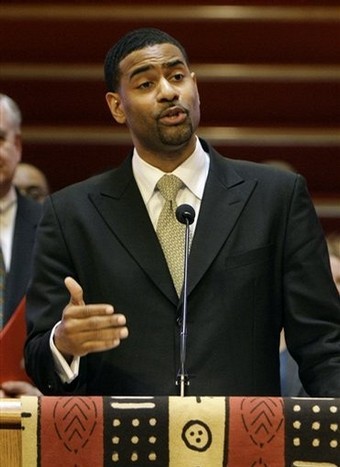
Rev. Otis Moss III preaching it up.
Gospel Remix: Reaching the Hip Hop Generation
 
that was written in 2007, I'm automatically skeptical. Most cultural critics I've encountered consider the "hip hop generation" to be a pretty broad term for African Americans born after the Civil Rights Movement. And with hip hop's roots in the 1980s, it's a genre that's been recognized in pop culture for over 30 years. As early as 2006, cultural critics were writing that African American youth coming of age at the turn of the millennium were better understood to be a "post hip hop generation." So, in reaching Rev. Otis Moss III's chapter, "The Hip Hop Pastor as Postmodern Prophet," I was unsure what to expect. Was it going to be dated advice already? Praise God, it's not.

Moss does a good job of contrasting "soul culture"--the culture out of which artists like Rev. Al Green, Jackie Wilson, and Aretha Franklin emerged--and "hip hop culture." For Moss, hip hop culture has prophetic roots in its cultural critique, but has since been co-opted by mainstream America as just another cultural product. Moss sketches a vision of hip hop at its best--a prophetic word against forces of oppression, domination, and injustice with a voice and sound deeply rooted in African and African American experience and tradition. In fact, Moss sketches the same vision for the church, in this way articulating that the co-opting of hip hop is no different than the co-opting of church that has happened over the course of the last few decades. Rather than functioning as cultural critics, Moss sees both hip hop and the church functioning as cultural products. He calls the church to adopt the spirit of hip hop to recover its unique voice in a world that sounds like the same old stuff.

By the end of this, I realized that Moss' critique could be applied to any counter-cultural movement in any tradition, be it punk rock, indie rock, folk, Americana, etc. His critique didn't just speak to the African American church experience, but to the American church experience. 

Some favorite quotes:
  • "The strength of the church--particularly the black church--when rooted in a liberation ethic is revolutionary transformation through Christ. The church is one of the only places where the people are forced to struggle together in community and come to grips with the message of a Savior who demands not personal salvation but community trasnformation" (118).
  • "African American faith has always wrapped its worship experience in the existential and eschatological. In other words, we have always worshiped with one foot in the soil of our present pain and another foot in our future hope" (124).
  • "...African American children and adults are bombarded with images that perpetuate ungodly, racist, and destructive stereotypes. The church should be a place where children of color see themselves in a positive light. It is critical that the church place symbols, artifacts, and photographs that show African people as a part of the ancient biblical world. Christ should never be depicted as a European in a black church but at least Afro-Asicatic! His disciples should be viewed in a variety of dark and light hues reflective of the ancient world they occupied" (126).
  • "We must be clear on this: the hip hop generation sees people with passion and conviction all the time...The church, beyond all others, has someone named Christ to be passionate about, but many of our traditional churches have lost all sense of passion. Only when passion is rekindled can celebration truly take place" (127-8).
  • "Music in the church context, though it has the high calling to illuminate Christ, also is trapped by the cultural memory of the congregation. When a person says, "I don't like that song," he or she is really saying, "That song invokes no memory for me."...The clash between generations is as much about new and old memories as it is about methodology." (130).
  • Music done well with the ethic of inspiration demands that we use what will undergird the Word, regardless of style (130).
  • Moss' Post-Soul Tests scattered throughout the chapter are really excellent ways to frame questions about one's church culture.

Friday, May 16, 2014

Heard the Word: David Ruhe

David Ruhe, looking quite happy.
Today, I headed to Eden Theological Seminary for a special worship service for those graduating this evening. The preacher was David Ruhe, a pastor in the UCC tradition currently serving at Plymouth UCC in Des Moines, Iowa. His message was entitled, "Welcome to the Wilderness," using Exodus 17: 1-7. Now, I must be perfectly honest and say that I was there with my 17 month old daughter Jo, which made for an interesting experience. I had come armed with sliced bananas, Cheerios, water, and a variety of quiet toys in order to make it through the service, and mostly succeeded. I was able to sit through the whole sermon as Jo bot up and down from the chair next to me, played quietly, and ate and drank. Though my attention was diverted through much of the sermon, I was able to follow it pretty well. I attribute this to Ruhe's humorous, storytelling style. Below are just little things I wanted to make note of:


  • Scripture Reading: Graduating student Cheree Trent Mills read Scripture, and did a fantastic job. I am wondering if she spoke to Ruhe beforehand, because I felt like her reading centered so strongly on   verse 4: So Moses cried out to the Lord, “What shall I do with this people? They are almost ready to stone me.”
  • Ruhe is a great storyteller. He shared the story of the first spaghetti dinner he did as a youth director right out of seminary, and it was great. He included such great descriptions of the scene, his feelings, expressions, and voice that I could really see the scene. A standout: his description of wheeling like a wild animal kneeling over its prey to growl at the senior pastor as he checked up on him. Ruhe also used a lot of impressions and caricatured voices in his sermon that really worked for him.
  • Ruhe was funny. Even my 17 month old caught on and laughed, because he had everyone there chuckling along with his tales.
  • His message about ministry was a simple one--about how entering ministry is entering into Moses' leading the Isrealites through the wilderness. But what Ruhe emphasized was that it needn't be a lonely space for new leaders. Instead, it could be a humerous space. A space shared with the laughter of colleagues. A space filled with the stories and misgivings of those who have come before you. 
  • Ruhe didn't dig all that deep into the Scripture passage (or if he did, I missed it in trying to keep the Cheerios flowing), but he did make enough of a connection to keep it rooted there--seems like what I often do.
  • Grace of this Message: Honestly? I think a part of the grace is that I could listen with one ear while tending a toddler and not feel like I missed anything. The other? He found a way to say, "Welcome to Ministry" without it sounding like either a threat or apology. That's hard to do.