Showing posts with label reading up. Show all posts

Sunday, June 8, 2014

Reading up: The Idolatry of God by Peter Rollins

What's unique about The Idolatry of God: Breaking our Addition to Certainty and Satisfaction is that it's not a book for pastors, for preachers, for people who are thinking about preaching, or for church leadership (though any of them would get something out of the read). Rather, it's written in a way that the average unchurched or nominally-churched person could read it. The content is good, but what I'm interested in is how Peter Rollins puts the thing together.

Rollins is a great storyteller, and it's through storytelling that he illustrates some pretty dense theological material in a way that is understandable to people whose only experience of theology is through popular culture or the Christians who make it on the news. What I think is important about how Rollins writes is that it isn't dumbed down--he uses theological language, latin phrases, deep philosophical concepts, and theoretical ways of exploring ideas that aren't pedantic or pandering. I think this is the biggest fault of many church leaders seeking to reach a biblically illiterate generation--they speak and preach as though this illiteracy is actually infancy rather than taking the wealth of experience and theologizing the individual has likely done on her own before a religious professional even walked in the room.

Rollins incorporates stories in ways that layer upon each other, so that he's drawing you into a comfortable textual world in which you he introduces you to stories, then points out their relationship to the faith world. In discussing idolatry, he refers to "the MacGuffin," a term used in film making to discuss the item everyone's after, the magnet of the film, so to speak. In a chapter on self and identity, he uses a Miami Vice episode to explore the concept. And the conclusion is a sketch of a poor but whole woman who works miracles, raises suspicions of the authorities, and brings a renewed sense of peace to those she encounters (sound familiar?).

Though the use of popular culture is often taken as good "illustrations" for sermons, it's rare to see them used to such excellent effect as Rollins does. He's not using them to look cool (I mean, Miami Vice?). He's not using them in a way that sounds inauthentic. Rather, he's using them because they are vehicles that make his point in ways that are easily understandable and don't depend on an entirely new theological vocabulary to engage. They take the stuff of theology and make it accessible, make it so it seems like something that actually happens in real life.

The book itself is more a theology book than preaching text, but I do think that the way Rollins puts together the work is worth taking note of. First of all, he takes pop culture seriously as a story-telling medium that can convey meaningful information. He doesn't appropriate it simply to be hip and with it. Instead, he fleshes out the vehicles in ways that are legitimately helpful. (I had never seen an episode of Miami Vice and yet found his explanation quite compelling and easy to follow.) 

So...it's got me back on my line of thought about language. Rollins spends much of the text redefining, nuancing, and massaging some hefty theological terms. But he doesn't do it in biblical terms, theological terms, or in terms related to church history. Instead, he's focused on stories. And stories that people will be literate to. I think this in itself is an important notion in my developing understanding of vocabulary for preaching--that stories matter more than the language does, in many cases. Perhaps it's a Brueggemann case after all, with the contents being more important than the vessel.


Saturday, June 7, 2014

Reading Up: Preaching as Testimony by Anna Carter Florence

I'm not going to spend a lot of time on Preaching as Testimony right now, as I'm mostly writing for my preparation for coursework for my summer class, and I think this text was added just to toss in a work by Anna Carter Florence before the Festival of Homiletics. It's a great text, don't get me wrong. I read it earlier this year for my introductory preaching course. But it's definitely not in the same vein as the other texts I've been engaging recently. It's a fantastic work to being working toward both a theology of preaching (or of updating one) and a sermon preparation method that takes God's immanent action in the world seriously (no surprises there, given her lecture at the Festival).

As a woman who considers herself somewhat of a church outsider, the first section which deals with the stories of three incredible women preachers was incredibly empowering. Their preaching deals directly with the stuff of their lives, their congregations were the people that God set before them, and it helped to strip away some of the pressure one feels to have it "all together" as a preacher.

I highly recommend it. Just don't have a lot of comments for the purposes I'm working toward now. Perhaps in the future, I'll come back to this text and flesh out some thoughts further.

But for now, choice quotes:

  • "...you cannot rely on others to make you a preacher. You cannot preach the text if you are trying to prove that you can preach the text. You have to change the subject and testify for yourself" (112).
  • "You cannot preach God's Word without putting your own work, unprotected, on the line" (115).
  • "A preacher who succumbs to the constant pressure to be 'more entertaining,' or 'more relevant,' or even 'more biblical' (in the myriad of ways that phrase gets tossed around), eventually communicates that unless it is entertaining, it is not gospel; unless it meets my needs, it is not good news; unless it is in my words, it is not Word" (122).
  • "We reside among the people so that the people and the Word may reside in us. And when the Word is 'in residence' in us, in ways we can see and hear, we have something to say; we have a Word to speak" (155).
  • "Being honest is harder than being creative; engaging the text is harder than choosing a form. But there is a peace that comes from making it all the way to testimony, and you can see it in a preacher when she sits down after that sermon...the truth is, she does know how she did it; she just knows that she did, and on nothing but sheer grace" (157).

Reading Up: Preaching at the Crossroads by David J. Lose

Ok. I was hard on poor David Lose in my earlier post. Really hard. Like, perhaps unfairly hard. Because in Preaching at the Crossroads: How the World--and Our Preaching--Is Changing, the man does an admirable job of conveying the landscape of our current context for folks in the pews. And it made me feel like he maybe would have actually understood what it felt like to walk into a giant church full of pastors as a most-of-my-life unchurched person. Maybe he would understand my frustration, disappointment, and inability to understand how the church as it is now has been incapable of conveying the Word to so, so many of my peers. It makes me sad. It makes me angry. It makes me want to work insanely hard. And it makes me want to work with fellow clergy who want to learn a new way, too.

For me, Lose gave me many words for things that I wasn't sure how to express about the state of preaching in the post-Christian, Western society. While I've been living and breathing this context for my entire life, and then studying it intensively in my amazing progressive seminary, I realized that many working pastors may not have a real grasp on the implications of postmodernity, secularism, and pluralism in the everyday lives of their congregants (and potential congregants). Lose spends three chapters unpacking each of these terms, and then a subsequent three chapters providing practical advice for preachers who want to engage these concepts in real ways in sermon preparation, planning, and delivery.

One thing that I do want to touch on is the way he discussed the idea of biblical fluency. I noted my concerns with Willimon's work and with Barbara Brown Taylor's remarks about biblical language, and how I'm generally uncomfortable with biblical language itself being considered normative for Christians. There is something about that idea of teaching an entirely new vocabulary that has the ring of shibboleth to it. But Lose, in a parenthetical, nearly toss-off moment says that he believes Christian churches need to promote biblical fluency, or "the ability to think--without thinking--in the target language." In this way, I understand biblical fluency not to be about vocabulary, but sight. Not flashcards, but paradigm. And that's something that I don't think language is capable of doing.

Though I didn't feel like Lose was saying anything radically different than many of the folks I've been reading or that I heard at the Festival said, he did so in a way that was pastoral and clear. And in this way, it helped me to understand that in many ways, many of the clergy who I am so frustrated with are just not quite equipped yet to deal with the tasks at hand. Or, they feel like they need a prescription for success. At the end of Lose's work, like so many works on preaching right now, he acknowledges that he hasn't offered something more concrete for the preacher to put into action (though I think he does put some excellent concrete ideas out there). But he doesn't apologize for it. Rather, he seems to be excited about the adventure of rediscovering what preaching might mean here and now and in the future. And that made me excited about it. Actually, it made me excited about what I might have to contribute to the conversation myself. So, yeah. Nicely done, David Lose.

Some choice quotes:


  • "If we are called to proclaim good news that is not just old news or the daily news but regularly surprises and even arrests our hearers, then perhaps preachers should not be surprised by the inherent and unending challenge of doing that" (3).
  • "Does Scripture...have nothing more to say to us than what we have already heard and perceived?" (39).
  • "...we preachers do not come to Scripture without a set of questions influenced by our context and experience. And we should not, as our questions are what bring us to the text in the first place. At the same time, by admitting that our context and experience powerfully shape not only our questions for Scripture but also our expectations of Scripture, we make room for others--including the voices within the Scriptures--to call into question our questions, both keeping us honest and keeping a vibrant conversation going" (41). 
  • "In this way, the preacher comes not as the trained expert designated to give a guided tour of an ancient text--let alone perform a postmortem on a dead confession of faith--but rather as an experienced guide and host who makes claims, suggests lively interpretations, makes a wager about the present-day meaning and interpretation of a passage, and ultimately invites the hearer not just to take these claims and confessions seriously but also to respond to them in word and deed" (45). 
  • "...we have unintentionally affirmed the secular impulse to restrict God's activity and therefore have made it increasingly difficult for our people to imagine being 'called' in their daily lives in the secular world. In particular, we have so greatly stressed the importance of Sunday activities that we have unintentionally devalued the lives we lead during the rest of the week" (69).
  • "Visit your people in their vocational arenas, and describe those visits in your preaching...Perhaps it's we who feel odd or out of place in the public venues of our people's lives, at least when we come as a pastor" (73).
  • "Over time, through this and other practices your congregation may grow from being a place where the word is preached more fully into a community of the word where all the members take some responsibility for sharing the good news of God's ongoing work to love, bless, and save the world" (77).
  • "Increasingly, researchers suggest that in a world saturated by meaning-making stories, the mainline church has failed to offer a compelling and central narrative identity that not only informs but also guides the lives of their congregants by providing a resilient religious identity" (100).
  • "Preaching from this framework, is equal measures (1) teaching of the basic worldview and how to apply it to life and (2) exhortation to do so" (103).

Wednesday, June 4, 2014

Reading Up: Crazy Christians: A Call to Follow Jesus by Michael B. Curry

The sermon out of which Michael B. Curry's book Crazy Christians: A Call to Follow Jesus came is the first chapter of his book, but it is also still available to be viewed online. It's a pretty tight sermon, and the book is just as tight. Curry refers to each chapter of the book as an essay in the preface, but it's also easy to read them as sermons (I'm guessing that's where they originated from), and so that's what I did.

The content of each of these messages is thoughtful, clear, connected both to the biblical text and to our current times. Curry is adept at pulling examples of Christian discipleship from historical figures and regular folks he has met on his journey. They have the rhythm and cadence of well-paced sermons, even when read silently (though in her forward, Rev. Dr. Katharine Jefferts Schori encourages us to read them aloud). When I have more time, I'd like to break down the construction of these messages a bit more to get at their flow, but for now, I just want to share some brief thoughts.

One thing that stood out for me is that the essay/sermons in this book often seemed to parallel the biblical text rather than have them at its center. Oftentimes, by the end of the chapter, I had to go back to the beginning to see what passage Curry had begun with to jog my memory. Though each sermon is not centered around the biblical text at hand does not mean that the text doesn't speak. Rather, Curry is never far from the text when he is creating tableaus and scenes from contemporary or historical or even other biblical cultures to illustrate the heart of the message. For me, it was helpful to see how Curry's sermons were soaked in the biblical text while also not feeling like they were a dull exegetical foray. Curry seemed mostly to be preaching on a biblical theme that he rooted in our own context with contemporary images and characters. In many cases, the connection with the text was often one word: "Crazy" in Chapter 1--"We Need Some Crazy Christians," "Something Greater" in Chapter 2--"We Are Part of Something Greater Than Ourselves," "Feet" in Chapter 3--"Following Jesus with Our Feet," and so on. It did not come of as gimmicky at all, but rather served as the hand hold that allowed him to straddle the divide between the text and today's context.

As I was reading, I kept wanting to hear a conversation between he and Walter Brueggemann regarding prophetic imagination. Curry's sermons seem to be dealing with the world and present circumstances in ways the Brueggemann would approve of--especially his message on what the true meaning of "gospel welcome" would be (see "The Gospel Witness of Welcome will Rearrange the World"). He writes, "We never know what can happen when we feel called to follow Jesus' gospel witness of welcome. Heeding such a call can require incredible courage. Sometimes this gospel way of welcome can lead us to put our very lives on the line. But Jesus' way of welcome can inspire us to keep working to do what is right in a world where too often too much is wrong" (113). And the move he makes of imagining the Galilee where Jesus will meet his disciples as today's global context: "We are, all of us, in Galilee" (128).

This is a book I will likely revisit soon, not only to do a little deeper digging into the sermons to understand their construction, but also for inspiration for how to preach in ways that are faithful to both the biblical text and our times.

Tuesday, June 3, 2014

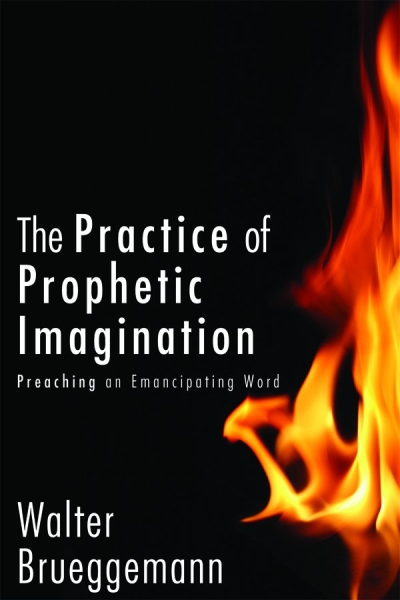
Reading Up: The Practice of Prophetic Imagination by Walter Brueggemann

Thank God. No, really. Thank. God.

Do you want to know how to begin to think about preaching to a post-modern assembly? Then read this book.

I kept putting off reading The Practice of Prophetic Imagination for a while. I don't know why. It felt intimidating. It felt overwhelming. It felt dense. And it was all of those things. But at the same time, I felt like Brueggemann (as usual) was saying things that needed to be said, setting an agenda that needed to be set, proclaiming the Word boldly. At the end of each chapter, I briefly considered giving Brueggemann a standing ovation. Then I thought my dog might think it was for her, and we don't want her getting a big head.

"Prophetic proclamation is an attempt to imagine the world as though YHWH--the creator of the world, the deliverer of Israel, the Father of our Lord Jesus Christ whom we Christians come to name as Father, Son, and Spirit--were a real character and an effective agent in the world" (2).

It sounds simple. It sounds obvious. But as Brueggemann takes the reader on a complete tour of the prophetic biblical canon, one sees how the obvious is over and over and over again occluded by the dominant culture. Brueggemann identifies our time as one caught up in "conventional idolatries and/or conventional atheisms," thus meaning that the preaching task is one that requires courage, imagination, and risky. Sign me up.

Brueggemann brilliantly and succinctly sums up the context of twenty-first century American context as being a strange mix of denial and despair. "In our denial, we keep imagining that it will all "work out" and that the failure of our society is not as deep or long term as we might suspect. In our despair, we have the sinking feeling that there will be no return to previous well-being, and we are left in a bad place about long-term prospects" (38). It is in this context that Brueggemann understand the preacher's task to be to name the denial, to name the despair, to allow for grief and woe and to understand God's role in it, and then, upon having sat in those dark places for a while, to begin to turn toward hope.

He traces this movement through the biblical prophetic literature, over and over teaching the contemporary preacher that prophetic preaching isn't only concerned with social justice issues or the problems at hand. Rather, it is a way of imagining the world anew with YHWH as the central character.

He outlines three major tasks of contemporary prophetic ministry:

  • To empower and enable folk to relinquish a world that is passing from us (136).
    • This requires dealing squarely with denial and despair.
  • To enable and empower folk to receive a new world that is emerging before our very eyes that we confess to be a gift of God (138).
Thus, prophetic awareness exists in a paradoxical state between:
  • God-given loss that actualizes the "woe" of being out of sync with God's purposes that require relinquishment. That relinquishment in turn produces denial. Thus:
  • There is a God-given new emergent that actualizes "the days are coming" by the wise generativity of God that requires receptivity. That receptivity in turn evokes despair. (142-143)
"I believe that prophetic ministry that swirls around truth (against denial) and hope (against despair) is undertaken not because of moral passion (though that counts) but because without prophetic processing of denial and despair, our society will devour itself in alienation" (143).

Perhaps my favorite part of this book is Brueggemann's honest confession that his book falls short of a how-to guide for the local preacher. Though the totalizing forces of our society that try to deny and rule out any possibility that the great God of our creation could possibly be a present, active agent here and now, through imagination, the prophetic preacher enters into a world unseen through that consumerist, militarist lens and sees a world of possibility, of hope, of love, of sustaining grace. There is no prescription for this because it is happening in new ways all the time. Our encounter with Scripture is always new because we are always something new, and this intersection creates the opportunity for even further newness. God is good.

By the end of the book, I kept thinking of Moss' work, not only in singing the blues (in which we do own despair), but in his discussion of Post-Soul generation. As I finished chapter four, "A Lingering Place of Relinquishment," I sat down at my computer and clicked on a link a friend had posted on social media. It was a young woman loudly proclaiming that she had had enough of society's beauty expectations of her, and that she would no longer be following them. Echoes of Brueggemann's and Moss' work in my mind, I fully realized how very desperate this age is to shed the totalizing society that seeks to convince us that there's nothing else there, but how at the same time, that desperation is a flailing one, without a hand hold. Without a prophetic tradition, without a God, we are denouncing something that only grows with the denouncement. Who, then, is announcing God?

The whole book seems revelatory in the way something so common-sense seems revelatory. Which, in some ways makes me sad. But in so many other ways, makes me excited. 

There were too many underlinings and stars in this book to actually quote, but here's a final teaser before you just go out and buy this book:

We do...yearn and trust for more than what the empire can offer. We yearn for abundance and transformation and restoration. We yearn beyond the possible. That impossible is given, when it is given, on the quivering lips of the poet who refuses the thin offer of the totalizers (149).

Reading Up: The Pastor as Minor Poet by M. Craig Barnes

What a gentle, lovely, pastoral little book. So often, I feel jarred and unsteadied by the preaching task, but Barnes does a beautiful job in The Pastor as Minor Poet of making one feel like that pastoral role is one of gentleness and ease, of walking along a beach, conversing with people as they come. I know it's not really like that. I know he knows it's not like that. But with so many of the texts we have read and the speakers we have seen thus far with an air of desperation around then, it's nice to breath in Barnes' measured pace.

What I appreciate most about this book is that Barnes takes the preacher as a whole person--living a family life, being imperfect, having a relationship with God, and doing the daily work of the pastor. In his introductions to the chapters, he lovingly sketches the mundane in a way that you begin to see the subtext he is pointing out so readily. So much of my enjoyment of this book was about the pacing, about the lingering, and about the lingering it encourages pastors to do in order to be poets of subtext.

In some ways, I could see the connection between this work and the work in parables that ACF is doing: both require a keen sensibility to the unseen in the present moment. And perhaps Barnes' work serves as a bit more of a how-to, though it is not didactic. Rather that teaching us how to be a poet, Barnes just seems to open up the world of what it would look like to be a pastor-poet. He doesn't sugar-coat the preaching task--he acknowledges that some days are easier than others. But he does emphasize the persistence and patience required in the task...things I could really work on.

Here are a few quotes:


  • "Poets see the despair and heartache as well as the beauty and miracle that lie just beneath the thin veneer of the ordinary, and they describe this in ways that are recognized not only in the mind, but more profoundly in the soul" (17).
  • "What the congregation needs is not a strategist to help them form another plan for achieving a desired image of life, but a poet who looks beneath even the desperation to recover the mystery of what it means to be made in God's image" (18).
  • "Poets are devote more to truth than to reality; they are not unaware of reality, but they never accept it at face value...This is why poets care about the text, what is said or done, but only in order to reveal the subtext, which reveals what it means" (19).
  • "In contrast to the biblical and theological poets, the pastoral poet has the unique calling of making sense of their worlds in light of the dust and grit of daily life in a parish....the pastor poet lives with a crowded and noisy soul. Central to what it means to be ordained is to open the doors of one's soul to the complexities, pathos, longings, and even sins of those the pastor has vowed to serve" (22).
  • But the creativity of the minor poet is found not in the discovery of new truth, or in speaking and writing for every other people. It's found in the fresh articulation of familiar old truths in a specific context. Clearly, that's what pastors do" (26).
  • "We wrap ourselves in small talk about small things in order to hide from holiness" (30).
  • "The secret to intimacy with another person is discovering the sufficiency of God's love without that person. It is the only way we are ever free to give love to another human being who can never meet the needs of our souls" (46).
  • "Since their souls are a sacred meeting ground, it is critical that pastors know how to expose themselves to God. It is not enough that they have learned as minor poets how to peer into the subtexts of the Bible and the congregation. They also have to attend to the underlying holy space of their own lives" (108).

Tuesday, May 27, 2014

Reading Up: The Preaching Life by Barbara Brown Taylor

Barbara Brown Taylor (or BBT as I like to call her now that we're BFF) has a real knack for saying what she's saying without saying it. Or, as my short story teacher called it, showing instead of telling. Perhaps because of the title of this book, I was expecting something a bit more prescriptive, but with BBT, prescriptive is never even on the menu (see 36).

But the closest she gets is in her chapter entitled, "Preaching." The chapters before have all been leading up to the vision of the preaching life, task, and moment that she presents here, so the concept in all its fullness isn't foreign at all, but seems an obvious extension of how she understands call, church, and the world. Most succinctly, BBT understands preaching to be a cooperative task between God, herself, and the community of faith--discount any of the three, and you have something that would be classified as other than preaching in BBT's book (ha!), I think.

The accumulated effect of her conversation about life, call, church, the world, and preaching is a sketch of the pastor as careful observer of the world and lives that God loves so, so dearly. And she is also the bearer of a difficult but good news that is not so easy to deliver or to receive if you're doing it honestly. It strikes me that BBT is so effective because she is so adept in that art of indirect speech Rollins emphasized. Though, I will say more in a moment about when that speech goes silent.

When I was in college, I majored in English and sociology. When people asked me what I was going to do with that, I would laughingly tell them, "I'm going to watch people, then write about it." At the time, I hadn't encountered the Gospel--at least not in any meaningful sense of the word 'encounter.' And so, as my vocation has become a bit more clear and as my faith has deepened and begun to truly shape my life, I would probably now say that I'm going to watch the world, listen for the Word, and then write about that.

The second half of The Preaching Life appears to be a collection of sermons. And so, I'm moving through those a little slower than the first half, savoring them. But one thing I notice about them is the same thing I noticed about her sermon at the Festival of Homiletics--they don't really have endings. I mean, they end. That's true. But they don't feel finished. I told a classmate it felt like being invited over for a meal, encountering a lavishly set table, lifting the lids of still-simmering pots to smell the flavors to come, beginning to have a good conversation over a glass of win, then, at the moment when supper will finally be served, of having all the food packaged up in Tupperware and sent home with you to reheat and eat in front of the television.

I think I understand that BBT creates these scenes, sets them in front of the congregation, and begins the task of looking at them together, expecting the examination to continue after that particular moment of examination is over. This is a subtle art. And I admire subtlety a great deal. But in the preaching task, sometimes the Good News needs some additional help in being revealed. And this is where celebration makes all the difference.

In my first preaching class last semester, Dr. Grundy had us write the 3-minute ending of our sermons first, emphasizing celebration. For many of us, this was a new idea, one we had to learn from textbooks, and then from actually hearing some of our classmates who knew what they were doing do it. It felt uncomfortable, I'll admit, to be asked to add so much flesh and skin to the sermon, but it was effective. Very few of us left the assembly wondering how God might carry us forward into the next day with the message we had just received. And I think this is what's missing from BBT's endings--the understanding that God's hand is held out to us in that moment for us to grasp and walk into the new life waiting there for us. And that takes daring, dedication, and imagination all at once.

And so, here's my preaching goal: to be BBT with celebration. Not a shabby goal, I don't think.

Here are a sampling of the quotes I want to continue to bathe in:

  • "God has given us good news in human form and has even given us the grace to proclaim it, but part of our terrible freedom is the freedom to lose our voices, to forget where we were going and why" (5).
  • "Our job is to stand with one foot on earth and one in heaven, with the double vision that is the gift of faith, and to say out of our own experience that reality is not flat but deep, not opaque but transparent, not meaningless but shot full of grace for those with the least willingness to believe it is so" (13).
  • "When God calls, people respond in a variety of ways. Some pursue ordination and others put pillows over their heads, but the vast majority seek to answer God by changing how they live their more or less ordinary lives" (27).
  • "For me, to preach is first of all to immerse myself in the word of God, to look inside every sentence and underneath every phrase for the layers of meaning that have accumulated there over the centuries. It is to examine my own life and the life of the congregation with the same care, hunting the connection between the word on the page and the word at work in the world. It is to find my own words for bringing those connections to life, so that others can experience them for themselves. When that happens--when the act of preaching becomes a source of revelation for me as well as for those who listen to me--then the good news every sermon proclaims is that that God who acted is the God who acts, and that the Holy Spirit is alive and well in this world" (33).
  • "Understood in this way, preaching becomes something the whole community participates in... If the preaching they hear is effective, it will not hand them sacks of wisdom and advice to take home and consume during the week, but invite them into the field to harvest those fruits for themselves, until they become preachers in their own right. Preaching is not something an ordained minister does for fifteen minutes on Sundays, but what the whole congregation does all week long; it is a way of approaching the world, and of gleaning God's presence there" (34).
  • "The church's central task is an imaginative one" (41).
  • "It is a matter of learning to see the world, each other, and ourselves as God sees us, and to live as if God's reality were the only one that mattered" (44).
  • "The theological word for this experience is revelation, but the process, I believe, is imagination" (48).
  • "My relationship with the Bible is not a romance but a marriage, and one I am willing to work on in all the usual ways: by living with the text day in and day out, by listening to it and talking back to it, by making sure I know what is behind the words it speaks to me and being certain I have heard it properly, by refusing to distance myself from the parts of it I do not like or understand, by letting my love for it show up in the everyday acts of my life. The Bible is not an object for me; it is a partner, whose presence blesses me, challenges me, and affects everything I do" (60).
  • "A sermon, on the other hand, is an act of creation with real risk in it, as one foolhardy human being presumes to address both God and humankind, speaking to each on the other's behalf and praying to get out of the pulpit alive" (74).
  • "When I say 'I' from the pulpit, I want them to say, 'Me too.'" (84).
  • "This is one of the hardest and most rewarding aspects of the job. We do not make sermons out of air; our creations, poor or brilliant as they may be, are always variations on someone else's theme. The main melody is always a given, and even when we launch into our own bold improvisations we are limited to a scale of eight notes" (87).


Reading Up: Unlearning Church by Michael Slaughter

As I was reading Michael Slaughter's Unlearning Church, I had this strange notion that I had read it before. I went to look at my bookshelf to see if it was shelved in my collection of "United Methodist Here's How To Do Church" books. It wasn't. But gazing at that ever-expanding shelf (the connection is always being educated), I realized I'd probably read a number of things very similar to this: a pastor of a large church (always male), writing in very general terms about a very specific way in which he has grown the Church (now, whether that is church is his church or THE church is another debate for another day). And so, I'm wondering what I can learn about preaching from it.

It's not a book about preaching, as much as it is a text that is wrestling with the space in which preaching happens--namely the church. Chapter 4, entitled "Thriving in Paradox" is a pretty helpful primer to postmodern culture, if you're not living in the middle of it already, and its tips about church itself are good things for preachers to consider as well: that knowing is not as important as experiencing; that hard questions do not require easy answers, but rather spaces where they can be asked; that diversity is a reality and actually leads to greater community than homogeneity. I guess this would be the greatest strength and weakness of the book: how it does a good job of identifying what church and leadership might look like in the postmodern world, and how obvious all of this is to a young leader already. Oh wellsies.

The second half of the book is geared directly toward church leaders, and it was there that I was able to glean a few things for preaching. I want to touch on Slaughter's idea of a "trainer-coach" that he outlines in chapter 7, "Replicating the DNA." He writes:

"In the church setting, we need to help trainer-coaches break down the messages presented in each worship experience so they can formulate specific plans according to the needs of those in their cell groups. We design each weekend worship experience with supplemental curriculum for the trainer-coaches to use." 

I've had some experience in churches who have used a Sermon/Learning style, but what Slaughter outlines here seems to be different--seems to be an intentional effort to equip leaders in the church to be able to engage the message presented in worship in ways that connect with a small group's life. My knee jerk reaction is that it is preposterous to know how the message is going to connect with an individual or a group. To plan a curricula around that seems kind of presumptuous. Then again, creating space to reflect on the message isn't a bad thing. How then might this idea be a little less top-down management-style and something that is more organically available to the congregation's small groups?

I was also intrigued by his description of the Family Room in chapter 3, "Engaging the Whole Person." Evidently, it started as an experimental space for in-between the Christmas Eve services where people could gather to converse, share prayer concerns, connect with trained lay-pastors, or...whatever else. It was set up like a living room with couches, candles, and coffee tables, and was hugely popular for folks leaving the services. It has evolved into an ongoing ministry at Ginghamsburg. Certainly in a large church, the setting of the family room has something to offer. It makes me think about the early Christian home churches, with the community gathered to hear the Word, pray, learn, and sing. I know the movement toward home churches and small in-home groups is a popular one, but I wonder how many of us have actually experienced hearing a sermon in that environment. Or actually processing a sermon immediately following worship. More things to chew on.

Though Slaughter claims to have abandoned the pastor-as-CEO model for church, his book still reads like a business how-to. But here are a few quotes that I'd like to chew on to inform my preaching:

  • "Some people at Ginghamsburg say, 'Mike, you don't feed me anymore.' Many of these people forget that our connection with God is never complete until we make the commitment to sacrifice our personal needs and come down from the mountains of our personal spiritual journeys to serve the needs of the oppressed and hurting all around us" (107).
  • "UnLearning leaders [or preachers?] go beyond the latest leadership fads and technological innovations to the ancient practices of spiritual formation--the practice of daily disciplines that Jesus was committed to, such as prayer, solitude, meditation on the Scriptures, fasting, fellowship, service, generous giving, and commitment to simplicity of lifestyle" (109).
  • "A Christian [preacher] is not someone who makes an intellectual statement of belief, or who commits to a lifestyle of little do-good-isms that have no spiritual motivation. A Christian is someone who is like Jesus" (113). What does it mean for the preacher to be like Jesus?
  • "Postmodern people are looking for authenticity. They do not seek explanations about God so much as they seek authentic life-demonstration of biblical relevance. UnLearning leaders are more about a demonstration of a greater-works-than-these, authentic faith than about simplistic Jesus slogans and magic faith formulas. Their greatest persuasion point is authentic life experience, not argumentative reasoning" (115). 
  • "So many times we try to tell other people the will of God in their lives, rather than that God's desire is simply to live in them, period" (119).
  • "You'll keep the godfathers and godmothers of your church very happy if you continue doing church the way you've always done it--without any risk or change. But we don't have time to play the kingdom of church. We have time only to obey one voice--the voice of God. Do not settle for anything less than God's creative purpose" (127).

Monday, May 19, 2014

Reading Up: Proclamation and Theology by William H. Willimon

The first book I picked up on my Festival of Homiletics reading list was William Willimon's Proclamation and Theology. In so, so many ways, I think that this was the exact book I needed to be reading now. The book reads like an enthusiastic, exhorting, cheering, encouraging, instructing sermon to preachers to get their theological act together about their preaching. He argues that the main issue with preaching today isn't an issue of style or accessibility, but rather is an issue of theology--AKA that it's needed in preaching.

This book was so chock full of gems that I'm going to have a tough time only sharing a few. But the biggest pieces I'm taking away have to do with the idea that in a strong theology of preaching, and preaching that takes its theological task seriously, the preacher doesn't matter all that much. God does. God, a constantly communicating Wordsmith, is taking our imperfect little selves and using us as vessels for the Word still being spoken out into the world today. For Willimon, the preaching task isn't to be taken lightly, isn't to be blown off, but is to be participating in God's continuing creative acts in this world.

What I especially love about Willimon's book is that it addresses failure. Failure by preachers, failure by the Word, failure as it realistically happens when the Word is not received. As a perfectionist, I'm struggling with this in my own preaching life, having a hard time not feeling like if I just studied harder, presented myself more generously, chose better words, that I would be able to pristinely convey this incredible message I've been given to share. Willimon says that's just not possible. And it's a relief, honestly.

My main issue with the text comes in the section in which Willimon encourages preachers to "talk like the Bible" (47). While his indication that this means presenting rich, multilayered sermons, various literary forms, and to honor the biblical world (he almost talks about it like the written Word is the New Jerusalem...hmm...) is something I can get on board with, I really struggled with his idea that we need to be teaching a new vocabulary to the congregation through preaching. I get what he's getting at--words like 'salvation,' 'sin,' 'suffering,' need to be given biblical context in order to really understand them as people of faith in the here and now. At the same time, I'm concerned about inaccessibility. To me, an important part of the preaching task is ensuring that this vocabulary isn't just adopted with definitions handed down. Rather, preaching turns that vocabulary inside-out, reaching deep into it to pull out meanings that reverberate in the present context. I think Willimon could get on board with that, but he walks a fine line in this section.

My favorite chapter was entitled "Cross and Resurrection in Preaching," and Willimon did an excellent job of fleshing out why preaching without the cross and resurrection is simple foolishness. What Willimon calls us to is Pauline foolishness--a turning upside-down of expectations to the point that the incredible things that come out of it absolutely have to be the work of God. And I'm all about some Pauline foolishness.

I love that this isn't a text that's a 7-step sermon preparation process, but instead is both the before, after, and why of a way of living life as someone who preaches. Like I said, right book at the right time.

Here are some particular gems:

  • "...preaching is not about us--not about you the listener or about me the preacher. Preaching is about God and by God or it is silly" (2).
  • "There is a reletntlessness about the speech of this God, an effusive loquaciousness, a dogged determination not to rest, not to fall silent, not to cease striving until every single one of us is part of the conversation. Therein is our hope. Here is a divine-human dialogue that is initiated and, at every turn in the road sustained, by a living, resourceful, long-winded God, thank God" (15). 
  • "We are to love the text more than we love our congregational context" (20).
  • "Much Christian worship ought to be predicated on the premise that, if we can get a group of ordinary, otherwise voiceless people to strut their stuff before the throne of God on Sunday, we will be able to do the same before the city council, or the Pentagon, or the administration on Monday" (27).
  • "Preaching is that sort of public speaking that strives never to be original. Preaching is Christian only when it is biblical, when it is obviously derivative of, submissive to, and controlled by the biblical word" (33).
  • "Favorite historical-critical questions--What is the earliest strata of this passage? How can this statement be credible to modern, scientific, western minds? Are these the genuine words of Jesus?--are not as relevant as Scripture's originating, homiletical question: Will you come forward, be part of a new, countercultural people of God, and follow Jesus where he leads you?" (34).
  • "The pastor bears the burden of listening on behalf of the whole church" (42).
  • "To be forced through our daily reading and interpretation of Scripture to see ourselves not primarily as servants of the whims of the congregation but rather as servants of the demanding Word can be true pastoral freedom" (46).
  • "The Word, by its very nature not self-evident, is prone to incomprehension and misunderstanding. Failure is everywhere for the Word" (52).
  • "A preacher is caught in that incarnational tension of having to speak a word for God but being utterly unable, by our humanity, to speak for God. The preacher must therefore stand up and proclaim in a  resonant, strong voice, 'Thus saith the Lord!' but at the same time confess with the young Isaiah, 'Woe is me! I am a person of unclean lips and dwell among a people of unclean lips'" (61).
  • "Sometimes the best sermons do not argue the congregation into something they have not yet known but rather point to and name that which the congregation undeniably knows" (76).
  • "'He is risen!' In a sense, this is as far as faithful preaching goes" (77).
  • So if preaching fails and fails often, preaching also, by the grace of God, succeeds. Despite all obstacles and hindrances, people do hear" (79).
  • "If there is one thing we preachers fear more than the possibility of crucifixion it is the potential of resurrection" (79).
  • "The essential patience required of preachers, the freedom from homiletical anxiety over the reaction of our listeners, the confidence in the power of the preached word to accomplish what it wants, is possible only if, in fact, Jesus did rise from the tomb" (82).
  • "Any pastor who is not tempted by despair has probably given in to the world too soon, has become dishonest or deceitful about his or her homiletical failures, has become too easily pleased by and accommodated to present arrangements, is expecting too little of the preached word. Weekly confrontation with the gap between what God dares us to say and what we are able to hear leads many of our best and brightest to despondency" (85). 
  • "Easter keeps differentiating the church from a respectable, gradually progressive, moral improvement society" (87).

Saturday, May 17, 2014

Reading Up: Hip Hop Pastor as Postmodern Prophet

At first, I thought this reading was going to be insanely dated. When I pick up a book called titled The
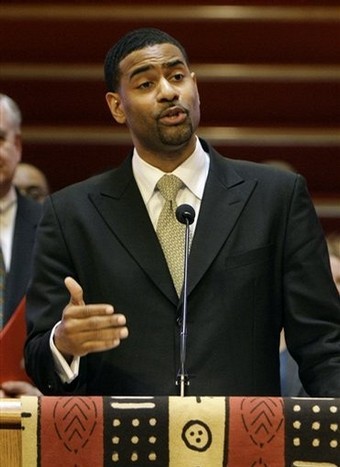
Rev. Otis Moss III preaching it up.
Gospel Remix: Reaching the Hip Hop Generation
 
that was written in 2007, I'm automatically skeptical. Most cultural critics I've encountered consider the "hip hop generation" to be a pretty broad term for African Americans born after the Civil Rights Movement. And with hip hop's roots in the 1980s, it's a genre that's been recognized in pop culture for over 30 years. As early as 2006, cultural critics were writing that African American youth coming of age at the turn of the millennium were better understood to be a "post hip hop generation." So, in reaching Rev. Otis Moss III's chapter, "The Hip Hop Pastor as Postmodern Prophet," I was unsure what to expect. Was it going to be dated advice already? Praise God, it's not.

Moss does a good job of contrasting "soul culture"--the culture out of which artists like Rev. Al Green, Jackie Wilson, and Aretha Franklin emerged--and "hip hop culture." For Moss, hip hop culture has prophetic roots in its cultural critique, but has since been co-opted by mainstream America as just another cultural product. Moss sketches a vision of hip hop at its best--a prophetic word against forces of oppression, domination, and injustice with a voice and sound deeply rooted in African and African American experience and tradition. In fact, Moss sketches the same vision for the church, in this way articulating that the co-opting of hip hop is no different than the co-opting of church that has happened over the course of the last few decades. Rather than functioning as cultural critics, Moss sees both hip hop and the church functioning as cultural products. He calls the church to adopt the spirit of hip hop to recover its unique voice in a world that sounds like the same old stuff.

By the end of this, I realized that Moss' critique could be applied to any counter-cultural movement in any tradition, be it punk rock, indie rock, folk, Americana, etc. His critique didn't just speak to the African American church experience, but to the American church experience. 

Some favorite quotes:
  • "The strength of the church--particularly the black church--when rooted in a liberation ethic is revolutionary transformation through Christ. The church is one of the only places where the people are forced to struggle together in community and come to grips with the message of a Savior who demands not personal salvation but community trasnformation" (118).
  • "African American faith has always wrapped its worship experience in the existential and eschatological. In other words, we have always worshiped with one foot in the soil of our present pain and another foot in our future hope" (124).
  • "...African American children and adults are bombarded with images that perpetuate ungodly, racist, and destructive stereotypes. The church should be a place where children of color see themselves in a positive light. It is critical that the church place symbols, artifacts, and photographs that show African people as a part of the ancient biblical world. Christ should never be depicted as a European in a black church but at least Afro-Asicatic! His disciples should be viewed in a variety of dark and light hues reflective of the ancient world they occupied" (126).
  • "We must be clear on this: the hip hop generation sees people with passion and conviction all the time...The church, beyond all others, has someone named Christ to be passionate about, but many of our traditional churches have lost all sense of passion. Only when passion is rekindled can celebration truly take place" (127-8).
  • "Music in the church context, though it has the high calling to illuminate Christ, also is trapped by the cultural memory of the congregation. When a person says, "I don't like that song," he or she is really saying, "That song invokes no memory for me."...The clash between generations is as much about new and old memories as it is about methodology." (130).
  • Music done well with the ethic of inspiration demands that we use what will undergird the Word, regardless of style (130).
  • Moss' Post-Soul Tests scattered throughout the chapter are really excellent ways to frame questions about one's church culture.

Wednesday, May 14, 2014

Reading Up: Knowing your message and preaching to the margins.


Reading Yvette Flunder's chapter in Birthing the Sermon, I was struck by two things: 1) She has such a clear understanding of the underlying gospel message she is charged with preaching. She writes, "That struggle [for equality, parity, and justice] is the long, strong, deep, resonant bass line of all I preach, sing, and pray about" (68). 2) She also has a deep sense of who her audience is when she preaches--those who are marginalized or feel marginalized by the church.

What is the bass line for my preaching? The line everything else hangs on?

And who is my audience? I already have a hint at this--I feel called to preach to those who don't realize that the church could be for them, that the gospel message could be for them, that God could be for them. Marginalized? Yes.

Favorite Quotes:
  • "Mine is a voice that passionately preaches justice and freedom with responsibility; however, not to the exclusion of Jesus" (68).
  • "People who have for generations been abused by the preaching of the Bible need to hear the Bible preached in ways that affirm and validate them" (68).
  • "The gospel is from the community as well as to it" (69).
  • "It is not enough for me to simply be profound; I must seek to be a profound blessing, by hearing from God and paying close attention to the 'voice' of the listening congregation" (69).
  • "We all keep secrets, so what would they[the biblical writers] rather we did not know?" (71).
  • Preaching to people who are on the edge of society and the mainline church must have good content and good form. Preaching to marginalized people mus be believable, powerful, and passionate" (73).