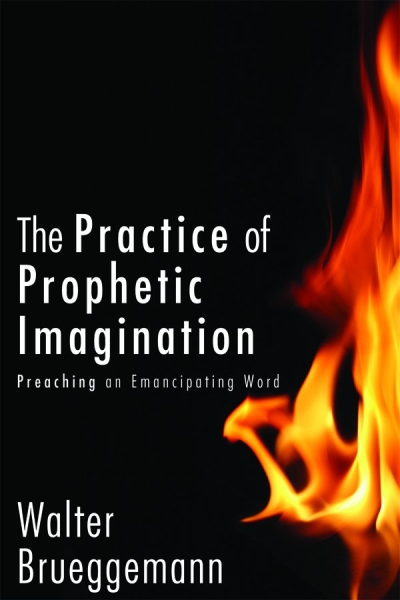
Do you want to know how to begin to think about preaching to a post-modern assembly? Then read this book.
I kept putting off reading The Practice of Prophetic Imagination for a while. I don't know why. It felt intimidating. It felt overwhelming. It felt dense. And it was all of those things. But at the same time, I felt like Brueggemann (as usual) was saying things that needed to be said, setting an agenda that needed to be set, proclaiming the Word boldly. At the end of each chapter, I briefly considered giving Brueggemann a standing ovation. Then I thought my dog might think it was for her, and we don't want her getting a big head.
"Prophetic proclamation is an attempt to imagine the world as though YHWH--the creator of the world, the deliverer of Israel, the Father of our Lord Jesus Christ whom we Christians come to name as Father, Son, and Spirit--were a real character and an effective agent in the world" (2).
It sounds simple. It sounds obvious. But as Brueggemann takes the reader on a complete tour of the prophetic biblical canon, one sees how the obvious is over and over and over again occluded by the dominant culture. Brueggemann identifies our time as one caught up in "conventional idolatries and/or conventional atheisms," thus meaning that the preaching task is one that requires courage, imagination, and risky. Sign me up.
Brueggemann brilliantly and succinctly sums up the context of twenty-first century American context as being a strange mix of denial and despair. "In our denial, we keep imagining that it will all "work out" and that the failure of our society is not as deep or long term as we might suspect. In our despair, we have the sinking feeling that there will be no return to previous well-being, and we are left in a bad place about long-term prospects" (38). It is in this context that Brueggemann understand the preacher's task to be to name the denial, to name the despair, to allow for grief and woe and to understand God's role in it, and then, upon having sat in those dark places for a while, to begin to turn toward hope.
He traces this movement through the biblical prophetic literature, over and over teaching the contemporary preacher that prophetic preaching isn't only concerned with social justice issues or the problems at hand. Rather, it is a way of imagining the world anew with YHWH as the central character.
He outlines three major tasks of contemporary prophetic ministry:
- To empower and enable folk to relinquish a world that is passing from us (136).
- This requires dealing squarely with denial and despair.
- To enable and empower folk to receive a new world that is emerging before our very eyes that we confess to be a gift of God (138).
Thus, prophetic awareness exists in a paradoxical state between:
- God-given loss that actualizes the "woe" of being out of sync with God's purposes that require relinquishment. That relinquishment in turn produces denial. Thus:
- There is a God-given new emergent that actualizes "the days are coming" by the wise generativity of God that requires receptivity. That receptivity in turn evokes despair. (142-143)
"I believe that prophetic ministry that swirls around truth (against denial) and hope (against despair) is undertaken not because of moral passion (though that counts) but because without prophetic processing of denial and despair, our society will devour itself in alienation" (143).
Perhaps my favorite part of this book is Brueggemann's honest confession that his book falls short of a how-to guide for the local preacher. Though the totalizing forces of our society that try to deny and rule out any possibility that the great God of our creation could possibly be a present, active agent here and now, through imagination, the prophetic preacher enters into a world unseen through that consumerist, militarist lens and sees a world of possibility, of hope, of love, of sustaining grace. There is no prescription for this because it is happening in new ways all the time. Our encounter with Scripture is always new because we are always something new, and this intersection creates the opportunity for even further newness. God is good.
By the end of the book, I kept thinking of Moss' work, not only in singing the blues (in which we do own despair), but in his discussion of Post-Soul generation. As I finished chapter four, "A Lingering Place of Relinquishment," I sat down at my computer and clicked on a link a friend had posted on social media. It was a young woman loudly proclaiming that she had had enough of society's beauty expectations of her, and that she would no longer be following them. Echoes of Brueggemann's and Moss' work in my mind, I fully realized how very desperate this age is to shed the totalizing society that seeks to convince us that there's nothing else there, but how at the same time, that desperation is a flailing one, without a hand hold. Without a prophetic tradition, without a God, we are denouncing something that only grows with the denouncement. Who, then, is announcing God?
The whole book seems revelatory in the way something so common-sense seems revelatory. Which, in some ways makes me sad. But in so many other ways, makes me excited.
There were too many underlinings and stars in this book to actually quote, but here's a final teaser before you just go out and buy this book:
We do...yearn and trust for more than what the empire can offer. We yearn for abundance and transformation and restoration. We yearn beyond the possible. That impossible is given, when it is given, on the quivering lips of the poet who refuses the thin offer of the totalizers (149).
