Showing posts with label generational rift. Show all posts

Wednesday, May 21, 2014

Preaching Lessons: Lillian Daniel

I hit up Lillian Daniel's sermon this morning. Her message--Noah's Ark--dealt with Genesis 6:1-9:16. I'm not going to spend much time discussing her sermon here (but I'll include a picture of my notes). For my preaching formation, there are two things I would like to emulate:

  • Daniel did an excellent job of dealing with the genre of the text. She handled its mythic nature by taking it so seriously it revealed the absurdity in doing so. She reached to other creation stories to help guide us through this assertion (namely, Adam and Eve), and then fleshed out what the metaphorical implications for the story are for her in this engagement of the text. Nicely done. 
  • I'm chewing on her question of whether Adam and Eve were kicked out or released from Eden and whether Noah and the Arkers (that would be an amazing band name) were free or stranded. She said, "There is no roadmap for how to be righteous. The Kingdom of God is within you. Paradise misplaced and paradise found. It's all in perception." For me, this connected to Anna Carter Florence's comments about sacramental vision
You guys, I talk with my hands a lot.
Here's me flapping them at Lillian Daniel.
What I really want to talk about, though, was Daniel's lecture, "Who's Asking? (Are We Answering Questions that Nobody's Asking)." It's helpful to know that Daniel is the author of the book When Spiritual but Not Religious Isn't Enough: Seeing God in Surprising Places, Even the Church. And I am thanking God for the work she is doing. Today, she took us on a survey of preaching in America to understand just how we got to the point of church irrelevance (because to many, it is). For most of the lecture, I just sat nodding, so grateful that somebody was putting words to my experience, that someone on the inside was able to tell all the church people, in their language, exactly what was up. Here are a few things I'd like to pass on:
  • The beautiful thing about pastoring a church now is that when a pastor looks out at the congregation, she sees people who actually want to be there. In his way, church shopping isn't a negative. It's a way of people making informed decisions about their faith life. And isn't that what we want?
  • She lifts up the liberating effect of having people who feel that they can mark the "None" box on the religious affiliation form. We don't want people coming to church because they have to in order to vote, in order to make business connections, in order to fit in.
  • She shifts the language of liberal and conserving traditions to one of open-mindedness and fundamenlism or literalism. I think this is helpful and a more accurate description of how different traditions handle Scriptural authority, encountering the Other, and a whole host of things.
  • She outlined how open-minded churches have tended to market themselves in three ways, none of which matter to people who are nominally or non-religious:
    • Through their activities
    • Through opposition (Well, I'll tell you what we're not...)
    • And through saying we are an alternative to fundamentalism/literalism. 
  • She outlines non-religious people as generally falling into four main categories:
    • No Ways--These people have been hurt by the church. Deeply. And actively avoid or are in conflict with the church in many ways.
    • Not Latelys--These people have experience of church, but drifted away and didn't feel anything lacking after they left.
    • Never Haves. These are individuals who have just never experienced church.
    • Not Yets.--These are people who have never experienced church, but who are open and curious. 
  • What matters to these people? Answering the question: Why does it matter to you that you follow Jesus?
  • As preachers, this means actually seeking to answer this question week-in and week-out when instead we are often trying to answer questions posed by seminary professors, by our culture, or even by arguing with the pastor down the street who has different doctrinal stances than you. She urges us to stop preaching answers to questions that nobody is asking, and instead to look to Scripture to help us wrestle with the question of why following Jesus matters to us.
  • And she argues that inevitably, this wrestling leads us to inclusivity, of wonder, of openness to God's movement in our lives and in the lives of people of different faiths (or no faith). So yeah. It matters.
Afterward, I went to meet Daniels and to thank her for her work. I told her that I was a "Not Yet" who has experienced a call to ministry. And then, I teared up. Being a former "Not Yet" in a church world that is still asking you to preach answers to irrelevant questions is hard. And I told her so. And I told her that I was grateful for her work because it helped those inside the church already understand how not to put the Not Yet leaders like me who have found a life-giving faith in Christianity into an irrelevant box that doesn't fit. Daniels was gracious and humble, but I hope she heard how important the work she is doing in making room for new leadership in the church. Because making room for them in the pews is one thing; letting them lead is another...and is an experience that I think will define the next era of Christianity in America...but not without a lot of growing pains. 

Preaching Lessons: Barbara Brown Taylor and MaryAnn McKibben Dana

In a dialogue and Q&A session, BBT and MAKD discussed parts of their writing work and their own engagement of the preaching task. I'm posting a picture of my full notes below, but I do want to make comments on a few points.

  • Language: In so many ways, language and its revision has come up in sessions today. I also mentioned it in my discussion of some of Willimon's work. I think as a person who grew up unchurched, I understand not the simple discomfort with "churchy language," but its misappropriation and misconstrual in popular media. What I think "sin" is is likely not what your average unchurched person thinks I think it is. I think one of my areas of strength in ministry is my ability to write, speak, preach, and pray in a vernacular that is sacred and yet accessible. I'm struggling some with a tension I feel from the generation above me in changing some of this language. BBT said something really excellent, though, "Revising our language completely can be dangerous. Sure, it's accessible, but any time we open the Bible, there is the language again. We have to deal with it." I agree with her sentiment that Bible paraphrases don't deal well with the problem, I also think that with translations like the CEB becoming more common (ha!), there are ways our language might change without abandoning sacredness. But still...it's something I'm chewing on.
  • MAKD on the Need To Knows for new preachers: 
    • There is nothing more interesting than the biblical text. No illustration. No story. Nothing.
    • Using Evernote has enabled her to organize her preaching thoughts so much better.
    • Not every meal you make is a 4-course masterpiece; a modest meal can also feed those present. (So, stop being a perfectionist preacher already, Chelsey.)
  • In the emergent church, the role of the pastor and the preaching task seem to be breaking open. It's an exciting time in which there seems to be a lot of opportunity to step outside of the standard 15-20 minute sermon box and to lean into the strengths of the preacher. Congregations are open to this. But BBT also shared that she thinks the preacher's role will always be as a "designated person among the community who speaks the truth of what is life-giving, meaningful, and will bear weight in a way that enables the gathered community to nod and say, 'Yes.'" Seems simplified, but I'm digging the image.

Tuesday, May 20, 2014

Festival of Homiletics: Monday Impressions


  • Central Lutheran Church rocked the hospitality in terms of making sure we knew where to go, felt comfortable in the space, etc. But, dudes...do not require me to go to registration before going to worship. It makes me feel like you think I don't belong.
  • Where the young people at?
  • No. Seriously. Where the young people at?
  • There are no young people in the program either? (For real. Nobody under 40.)
  • It was amazing to watch how the congregation acted during worship, especially with regards to seating. I watched a couple pace up and down and aisle twice, looking for seats. There were at least three rows of people who could have just scooted a little closer together to make room. Neither the people sitting nor the people looking for seats made any attempt to try. Hospitality isn't just for greeters, yo. This is especially terrifying when I consider that most of these people are probably pastors.
  • Where are the people of color at?
  • Central Lutheran is BEAUTIFUL. I could stare at that vaulted ceiling all day long.
  • Wait. Did I see a young person? Nope. Just someone wearing a bright jacket.
  • Making new homiletical friends is as easy as yelling "Brueggemann!" in a bar.

Heard the Word: Rev. David Lose Festival Of Homiletics 2014

David Lose looks quite pleased with himself.
Monday, May 19, 2014--6:30pm
"Singing Songs Old and New"
Ephesians 5: 15-20

Full disclosure: It took us like 25 minutes to walk the 3 blocks between our hotel and Central Lutheran Church because our little group of six is terrible at maps. When we walked into the church, worship had already started. We registered, then took our seats a few minutes into the sermon. So...maybe I missed some key parts. Keep that in mind as you read on.

Shortly after sliding into my seat, Lose began to talk about the phenomenon of hearing a song on the radio--a song one hadn't heard in years--and upon hearing it, being able to recall every word. At this, he launched into the chorus of "American Pie," with the 1,800 person congregation joining him. At the conclusion of the chorus, the assembly seemed genuinely amazed by the experience, and I sat stunned. These are not my people, I thought.

As Lose continued, he did talk about song having different functions--of building comradery, of helping to pass the long, difficult hours in certain dark periods of life, of uniting, of teaching the faith. He continued on in this vein for a while, fleshing out several examples, making some tidy connections. And as he concluded, he challenged those assembled to imagine a world without song. And then he asked us to imagine if the congregation would lead the world in song. And then we proceeded to BUTCHER "Amazing Grace" in a way I have never experienced...and I have sung "Amazing Grace" with a room full of people with advanced dementia.

As you can probably tell, this message bothered me. Deeply. I mean, it was all very nice. It was all very sweet. But come on! Music is so much more than nice and sweet! Maybe it's my reading of Moss informing my thoughts here, but music is so much more than what he's even touching on. And what Paul is calling the Ephesians to in this letter is so much more than nice and sweet hymn-sings. Music can be a weapon, subversion, unifying, sanctifying. I was waiting for the thunder of this message and only got a light mist, reminiscent of the drizzle falling as we walked to the church.

Even more than the surface nature of the message, I was bothered by the...well...the churchy-ness of it all. It felt like church people talking about and enjoying how great it is to be church people and how great it is to sing church songs. Which is wonderful. If you are a church person. I picked up on church music quickly because I love music and because one space I could regularly make music was in church. But your average unchurched millenial isn't going to walk in off the street knowing the verses to "A Mighty Fortress Is Our God." Sorry, Luther. So, what then? In Lose's imagined congregation leading the world in song, what song are they singing? And would anyone else know the words?

I was also bothered by the smallness of the vision. It seemed in Lose's final vision that he was asking the world to join in one song, blending in harmony as they sang the words. But what hymnal would the world be using (because it was made clear it would be from a hymnal)? What version? What tempo? What language would the words be in? This is a long-winded way of saying that what I heard in this message was a vision of the world that doesn't actually take a pluralistic, multicultural, varied, beautiful, diverse world seriously. And that bothers me. Deeply.

Music? Yes. But singing the old songs because that's all you know? No. Definitely not.

Saturday, May 17, 2014

Reading Up: Hip Hop Pastor as Postmodern Prophet

At first, I thought this reading was going to be insanely dated. When I pick up a book called titled The
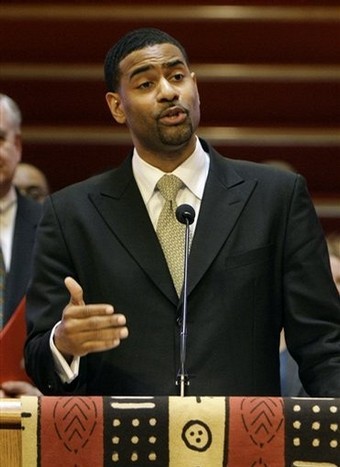
Rev. Otis Moss III preaching it up.
Gospel Remix: Reaching the Hip Hop Generation
 
that was written in 2007, I'm automatically skeptical. Most cultural critics I've encountered consider the "hip hop generation" to be a pretty broad term for African Americans born after the Civil Rights Movement. And with hip hop's roots in the 1980s, it's a genre that's been recognized in pop culture for over 30 years. As early as 2006, cultural critics were writing that African American youth coming of age at the turn of the millennium were better understood to be a "post hip hop generation." So, in reaching Rev. Otis Moss III's chapter, "The Hip Hop Pastor as Postmodern Prophet," I was unsure what to expect. Was it going to be dated advice already? Praise God, it's not.

Moss does a good job of contrasting "soul culture"--the culture out of which artists like Rev. Al Green, Jackie Wilson, and Aretha Franklin emerged--and "hip hop culture." For Moss, hip hop culture has prophetic roots in its cultural critique, but has since been co-opted by mainstream America as just another cultural product. Moss sketches a vision of hip hop at its best--a prophetic word against forces of oppression, domination, and injustice with a voice and sound deeply rooted in African and African American experience and tradition. In fact, Moss sketches the same vision for the church, in this way articulating that the co-opting of hip hop is no different than the co-opting of church that has happened over the course of the last few decades. Rather than functioning as cultural critics, Moss sees both hip hop and the church functioning as cultural products. He calls the church to adopt the spirit of hip hop to recover its unique voice in a world that sounds like the same old stuff.

By the end of this, I realized that Moss' critique could be applied to any counter-cultural movement in any tradition, be it punk rock, indie rock, folk, Americana, etc. His critique didn't just speak to the African American church experience, but to the American church experience. 

Some favorite quotes:
  • "The strength of the church--particularly the black church--when rooted in a liberation ethic is revolutionary transformation through Christ. The church is one of the only places where the people are forced to struggle together in community and come to grips with the message of a Savior who demands not personal salvation but community trasnformation" (118).
  • "African American faith has always wrapped its worship experience in the existential and eschatological. In other words, we have always worshiped with one foot in the soil of our present pain and another foot in our future hope" (124).
  • "...African American children and adults are bombarded with images that perpetuate ungodly, racist, and destructive stereotypes. The church should be a place where children of color see themselves in a positive light. It is critical that the church place symbols, artifacts, and photographs that show African people as a part of the ancient biblical world. Christ should never be depicted as a European in a black church but at least Afro-Asicatic! His disciples should be viewed in a variety of dark and light hues reflective of the ancient world they occupied" (126).
  • "We must be clear on this: the hip hop generation sees people with passion and conviction all the time...The church, beyond all others, has someone named Christ to be passionate about, but many of our traditional churches have lost all sense of passion. Only when passion is rekindled can celebration truly take place" (127-8).
  • "Music in the church context, though it has the high calling to illuminate Christ, also is trapped by the cultural memory of the congregation. When a person says, "I don't like that song," he or she is really saying, "That song invokes no memory for me."...The clash between generations is as much about new and old memories as it is about methodology." (130).
  • Music done well with the ethic of inspiration demands that we use what will undergird the Word, regardless of style (130).
  • Moss' Post-Soul Tests scattered throughout the chapter are really excellent ways to frame questions about one's church culture.