Monday, May 19, 2014

Reading Up: Proclamation and Theology by William H. Willimon

The first book I picked up on my Festival of Homiletics reading list was William Willimon's Proclamation and Theology. In so, so many ways, I think that this was the exact book I needed to be reading now. The book reads like an enthusiastic, exhorting, cheering, encouraging, instructing sermon to preachers to get their theological act together about their preaching. He argues that the main issue with preaching today isn't an issue of style or accessibility, but rather is an issue of theology--AKA that it's needed in preaching.

This book was so chock full of gems that I'm going to have a tough time only sharing a few. But the biggest pieces I'm taking away have to do with the idea that in a strong theology of preaching, and preaching that takes its theological task seriously, the preacher doesn't matter all that much. God does. God, a constantly communicating Wordsmith, is taking our imperfect little selves and using us as vessels for the Word still being spoken out into the world today. For Willimon, the preaching task isn't to be taken lightly, isn't to be blown off, but is to be participating in God's continuing creative acts in this world.

What I especially love about Willimon's book is that it addresses failure. Failure by preachers, failure by the Word, failure as it realistically happens when the Word is not received. As a perfectionist, I'm struggling with this in my own preaching life, having a hard time not feeling like if I just studied harder, presented myself more generously, chose better words, that I would be able to pristinely convey this incredible message I've been given to share. Willimon says that's just not possible. And it's a relief, honestly.

My main issue with the text comes in the section in which Willimon encourages preachers to "talk like the Bible" (47). While his indication that this means presenting rich, multilayered sermons, various literary forms, and to honor the biblical world (he almost talks about it like the written Word is the New Jerusalem...hmm...) is something I can get on board with, I really struggled with his idea that we need to be teaching a new vocabulary to the congregation through preaching. I get what he's getting at--words like 'salvation,' 'sin,' 'suffering,' need to be given biblical context in order to really understand them as people of faith in the here and now. At the same time, I'm concerned about inaccessibility. To me, an important part of the preaching task is ensuring that this vocabulary isn't just adopted with definitions handed down. Rather, preaching turns that vocabulary inside-out, reaching deep into it to pull out meanings that reverberate in the present context. I think Willimon could get on board with that, but he walks a fine line in this section.

My favorite chapter was entitled "Cross and Resurrection in Preaching," and Willimon did an excellent job of fleshing out why preaching without the cross and resurrection is simple foolishness. What Willimon calls us to is Pauline foolishness--a turning upside-down of expectations to the point that the incredible things that come out of it absolutely have to be the work of God. And I'm all about some Pauline foolishness.

I love that this isn't a text that's a 7-step sermon preparation process, but instead is both the before, after, and why of a way of living life as someone who preaches. Like I said, right book at the right time.

Here are some particular gems:

  • "...preaching is not about us--not about you the listener or about me the preacher. Preaching is about God and by God or it is silly" (2).
  • "There is a reletntlessness about the speech of this God, an effusive loquaciousness, a dogged determination not to rest, not to fall silent, not to cease striving until every single one of us is part of the conversation. Therein is our hope. Here is a divine-human dialogue that is initiated and, at every turn in the road sustained, by a living, resourceful, long-winded God, thank God" (15). 
  • "We are to love the text more than we love our congregational context" (20).
  • "Much Christian worship ought to be predicated on the premise that, if we can get a group of ordinary, otherwise voiceless people to strut their stuff before the throne of God on Sunday, we will be able to do the same before the city council, or the Pentagon, or the administration on Monday" (27).
  • "Preaching is that sort of public speaking that strives never to be original. Preaching is Christian only when it is biblical, when it is obviously derivative of, submissive to, and controlled by the biblical word" (33).
  • "Favorite historical-critical questions--What is the earliest strata of this passage? How can this statement be credible to modern, scientific, western minds? Are these the genuine words of Jesus?--are not as relevant as Scripture's originating, homiletical question: Will you come forward, be part of a new, countercultural people of God, and follow Jesus where he leads you?" (34).
  • "The pastor bears the burden of listening on behalf of the whole church" (42).
  • "To be forced through our daily reading and interpretation of Scripture to see ourselves not primarily as servants of the whims of the congregation but rather as servants of the demanding Word can be true pastoral freedom" (46).
  • "The Word, by its very nature not self-evident, is prone to incomprehension and misunderstanding. Failure is everywhere for the Word" (52).
  • "A preacher is caught in that incarnational tension of having to speak a word for God but being utterly unable, by our humanity, to speak for God. The preacher must therefore stand up and proclaim in a  resonant, strong voice, 'Thus saith the Lord!' but at the same time confess with the young Isaiah, 'Woe is me! I am a person of unclean lips and dwell among a people of unclean lips'" (61).
  • "Sometimes the best sermons do not argue the congregation into something they have not yet known but rather point to and name that which the congregation undeniably knows" (76).
  • "'He is risen!' In a sense, this is as far as faithful preaching goes" (77).
  • So if preaching fails and fails often, preaching also, by the grace of God, succeeds. Despite all obstacles and hindrances, people do hear" (79).
  • "If there is one thing we preachers fear more than the possibility of crucifixion it is the potential of resurrection" (79).
  • "The essential patience required of preachers, the freedom from homiletical anxiety over the reaction of our listeners, the confidence in the power of the preached word to accomplish what it wants, is possible only if, in fact, Jesus did rise from the tomb" (82).
  • "Any pastor who is not tempted by despair has probably given in to the world too soon, has become dishonest or deceitful about his or her homiletical failures, has become too easily pleased by and accommodated to present arrangements, is expecting too little of the preached word. Weekly confrontation with the gap between what God dares us to say and what we are able to hear leads many of our best and brightest to despondency" (85). 
  • "Easter keeps differentiating the church from a respectable, gradually progressive, moral improvement society" (87).


Saturday, May 17, 2014

AUX SEND by Dan Smart

A poem from my good friend, Dan Smart. It, and other excellent poetry, can be found here at his website RHYTHM IS THE INSTRUMENT.

AUX SEND

Lest it should 
seem
as if he's actually singing 

you something—rest
assured, dear reader, that
he's merely returning 

back to the world 
what he's already heard—

a fraction 
or so 
of a whole lifetime later

only—darker,
more diffuse,
and a little less useful;

because a poet can't explain
even the tail-
end of things—he just covers it

quick—
with feathers. 

A more delicate tool.

I love to garden. Every part of it. From planning and learning to weeding and prepping beds, I love it all. And today, I spent some time in one of the raised beds in my backyard. It's been overgrown by daylillies--their roots were overtaking the soil, choking out even a knock-out rose bush that was in the corner, and I'd been eyeing the bed for a while, knowing something had to be done.

So, last week, without knowing exactly what I was going to do, I just began digging up all of those lilies. And if you've ever had to dig up a giant cluster of daylillies that have been growing that way for the better part of a decade, you know how difficult it can be to tear the clumps apart, to lever the tubers right out of the soil, shake off the dirt, and toss them aside. If you haven't had to do this, let me summarize by saying it is damned hard. Last week, I worked with a spade most of the time, leveraging my weight against the tension of the roots clinging to each other and the soil. I made it about an hour into the job and had cleared about three feet of space.

Today, after a week of rain, I set out again, dragging my spade and waste can behind me. I wasn't looking forward to this job. But on a whim, I grabbed a small hand rake from the rack in the garage, thinking it could come in handing in ridding the bed of any lingering gum balls from seasons past. Well, about five minutes in, inspiration struck, and I began to use the hand rake to help me loosen the soil around the root balls, to navigate around the stalks of the lilies in a way the blunt spade wouldn't have allowed. Though the task was still hard, I was amazed at how much easier it was with what I would have considered to be a delicate tool.

I wonder how often I do the same in my writing and preaching--start off with a tool that, while appropriate to the task, isn't quite refined enough to get at the heart of the task. Rather, I take broad stabs and find myself tugging and scraping through the soil of the work, laboring intensely all the while. What if there were a more delicate tool I might be using for this preaching task? What if rather than tearing and ripping the roots, I'm excavating instead? What then? What then?

Heard the Word: Rev. Frank A. Thomas on Happy

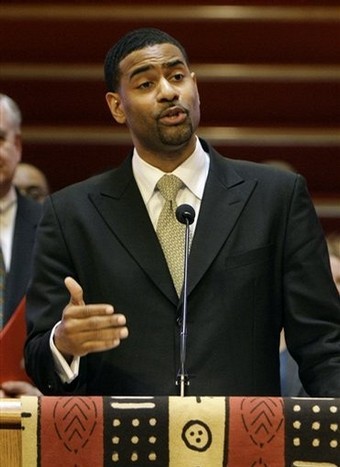
Last evening was commencement for Eden Theological Seminary's Class of 2014. Rev. Frank A. Thomas Matthew 5: 1-12. Having read one of his books for the preaching class I took this past semester, I was excited to experience his message firsthand. His message was dynamic, relevant, connected to the gospel message, and delivered in a way that made me feel spoken to and not preached at.
Rev. Frank A. Thomas--See? He talks with his hands.
offered a message entitled, "What Makes You Happy?" based on

Thomas' "exegetical bridge," as he called it, was to draw the connection between Pharrell William's hit song, "Happy" and the Beatitudes (working the translation from "Blessed are..." to "Happy are..."). Beyond just making a nicely little connection and pointing us towards a great pop culture artifact (he tipped me off to 24hoursofhappy.com--a 24 hour music video of people being happy to "Happy."), he dug deeper into both Pharrell William's story and the message of the Beatitudes to categorize 'happiness' as "offering your gift to the world in the purity of your call and in the discipline of your hard work." 

Over and over, Thomas came back to this phrase, molding it, defining it, redefining it, growing it, and eventually planting it into the hearts of those gathered to hear. By the end of the message, Williams' song had been redefined from a catchy hit to a call to discipleship, a celebration of living out the gifts God has given each of us in a way that is pure and disciplined. Perhaps one of the most powerful layers Thomas added to the message was his inclusion of Mother Teresa's "Anyway" poem. By the end of the message, he had everyone there responding to being "Happy, Anyway."

I think what stuck out most to me about experiencing Thomas' message in person is that his presence wasn't anything particularly striking. He talks with his hands, which was great for me to see. So far, I haven't seen many people who talk with their hands as much as I do preach from the pulpit. Seeing him do it helped me to understand how it might be possible for me to do the same. At the same time, he did have a nervous habit of messing with the tassel on his mortarboard cap, and pushing on his glasses.

But embodiment isn't want captivated us. It was the message itself. I had a deep sense that Thomas was simply convicted of the truth of his message, of the work he had put into it, and of the Spirit's work in its reception. It was the message that connected us to him in that moment, the message that did all the work for him. No doubt he read the room well, though, several times stopping and calling us to listen harder, to catch on to what the Word was speaking, and to respond to it ourselves. He was both teasing and gentle, assertive and generous, and he brought me to a space of excitement, honor, and truth about my own sense of call and how to live it out in the world.

The whole evening was a proud event. I watched people who I've watched come to bloom over the course of the last three years experience a culminating moment, and any time that happens, it is such a celebration. There was sweetness, a tinge of sadness, but overall excitement at the idea that if each of these people is able to live into the purity of his or her call and pair it with the discipline of his or her hard work, the world will be changed. That is reason for celebration, indeed.

Reading Up: Hip Hop Pastor as Postmodern Prophet

At first, I thought this reading was going to be insanely dated. When I pick up a book called titled The
Rev. Otis Moss III preaching it up.
Gospel Remix: Reaching the Hip Hop Generation
 
that was written in 2007, I'm automatically skeptical. Most cultural critics I've encountered consider the "hip hop generation" to be a pretty broad term for African Americans born after the Civil Rights Movement. And with hip hop's roots in the 1980s, it's a genre that's been recognized in pop culture for over 30 years. As early as 2006, cultural critics were writing that African American youth coming of age at the turn of the millennium were better understood to be a "post hip hop generation." So, in reaching Rev. Otis Moss III's chapter, "The Hip Hop Pastor as Postmodern Prophet," I was unsure what to expect. Was it going to be dated advice already? Praise God, it's not.

Moss does a good job of contrasting "soul culture"--the culture out of which artists like Rev. Al Green, Jackie Wilson, and Aretha Franklin emerged--and "hip hop culture." For Moss, hip hop culture has prophetic roots in its cultural critique, but has since been co-opted by mainstream America as just another cultural product. Moss sketches a vision of hip hop at its best--a prophetic word against forces of oppression, domination, and injustice with a voice and sound deeply rooted in African and African American experience and tradition. In fact, Moss sketches the same vision for the church, in this way articulating that the co-opting of hip hop is no different than the co-opting of church that has happened over the course of the last few decades. Rather than functioning as cultural critics, Moss sees both hip hop and the church functioning as cultural products. He calls the church to adopt the spirit of hip hop to recover its unique voice in a world that sounds like the same old stuff.

By the end of this, I realized that Moss' critique could be applied to any counter-cultural movement in any tradition, be it punk rock, indie rock, folk, Americana, etc. His critique didn't just speak to the African American church experience, but to the American church experience. 

Some favorite quotes:
  • "The strength of the church--particularly the black church--when rooted in a liberation ethic is revolutionary transformation through Christ. The church is one of the only places where the people are forced to struggle together in community and come to grips with the message of a Savior who demands not personal salvation but community trasnformation" (118).
  • "African American faith has always wrapped its worship experience in the existential and eschatological. In other words, we have always worshiped with one foot in the soil of our present pain and another foot in our future hope" (124).
  • "...African American children and adults are bombarded with images that perpetuate ungodly, racist, and destructive stereotypes. The church should be a place where children of color see themselves in a positive light. It is critical that the church place symbols, artifacts, and photographs that show African people as a part of the ancient biblical world. Christ should never be depicted as a European in a black church but at least Afro-Asicatic! His disciples should be viewed in a variety of dark and light hues reflective of the ancient world they occupied" (126).
  • "We must be clear on this: the hip hop generation sees people with passion and conviction all the time...The church, beyond all others, has someone named Christ to be passionate about, but many of our traditional churches have lost all sense of passion. Only when passion is rekindled can celebration truly take place" (127-8).
  • "Music in the church context, though it has the high calling to illuminate Christ, also is trapped by the cultural memory of the congregation. When a person says, "I don't like that song," he or she is really saying, "That song invokes no memory for me."...The clash between generations is as much about new and old memories as it is about methodology." (130).
  • Music done well with the ethic of inspiration demands that we use what will undergird the Word, regardless of style (130).
  • Moss' Post-Soul Tests scattered throughout the chapter are really excellent ways to frame questions about one's church culture.

Friday, May 16, 2014

Heard the Word: David Ruhe

David Ruhe, looking quite happy.
Today, I headed to Eden Theological Seminary for a special worship service for those graduating this evening. The preacher was David Ruhe, a pastor in the UCC tradition currently serving at Plymouth UCC in Des Moines, Iowa. His message was entitled, "Welcome to the Wilderness," using Exodus 17: 1-7. Now, I must be perfectly honest and say that I was there with my 17 month old daughter Jo, which made for an interesting experience. I had come armed with sliced bananas, Cheerios, water, and a variety of quiet toys in order to make it through the service, and mostly succeeded. I was able to sit through the whole sermon as Jo bot up and down from the chair next to me, played quietly, and ate and drank. Though my attention was diverted through much of the sermon, I was able to follow it pretty well. I attribute this to Ruhe's humorous, storytelling style. Below are just little things I wanted to make note of:


  • Scripture Reading: Graduating student Cheree Trent Mills read Scripture, and did a fantastic job. I am wondering if she spoke to Ruhe beforehand, because I felt like her reading centered so strongly on   verse 4: So Moses cried out to the Lord, “What shall I do with this people? They are almost ready to stone me.”
  • Ruhe is a great storyteller. He shared the story of the first spaghetti dinner he did as a youth director right out of seminary, and it was great. He included such great descriptions of the scene, his feelings, expressions, and voice that I could really see the scene. A standout: his description of wheeling like a wild animal kneeling over its prey to growl at the senior pastor as he checked up on him. Ruhe also used a lot of impressions and caricatured voices in his sermon that really worked for him.
  • Ruhe was funny. Even my 17 month old caught on and laughed, because he had everyone there chuckling along with his tales.
  • His message about ministry was a simple one--about how entering ministry is entering into Moses' leading the Isrealites through the wilderness. But what Ruhe emphasized was that it needn't be a lonely space for new leaders. Instead, it could be a humerous space. A space shared with the laughter of colleagues. A space filled with the stories and misgivings of those who have come before you. 
  • Ruhe didn't dig all that deep into the Scripture passage (or if he did, I missed it in trying to keep the Cheerios flowing), but he did make enough of a connection to keep it rooted there--seems like what I often do.
  • Grace of this Message: Honestly? I think a part of the grace is that I could listen with one ear while tending a toddler and not feel like I missed anything. The other? He found a way to say, "Welcome to Ministry" without it sounding like either a threat or apology. That's hard to do.

Wednesday, May 14, 2014

Reading Up: Knowing your message and preaching to the margins.


Reading Yvette Flunder's chapter in Birthing the Sermon, I was struck by two things: 1) She has such a clear understanding of the underlying gospel message she is charged with preaching. She writes, "That struggle [for equality, parity, and justice] is the long, strong, deep, resonant bass line of all I preach, sing, and pray about" (68). 2) She also has a deep sense of who her audience is when she preaches--those who are marginalized or feel marginalized by the church.

What is the bass line for my preaching? The line everything else hangs on?

And who is my audience? I already have a hint at this--I feel called to preach to those who don't realize that the church could be for them, that the gospel message could be for them, that God could be for them. Marginalized? Yes.

Favorite Quotes:
  • "Mine is a voice that passionately preaches justice and freedom with responsibility; however, not to the exclusion of Jesus" (68).
  • "People who have for generations been abused by the preaching of the Bible need to hear the Bible preached in ways that affirm and validate them" (68).
  • "The gospel is from the community as well as to it" (69).
  • "It is not enough for me to simply be profound; I must seek to be a profound blessing, by hearing from God and paying close attention to the 'voice' of the listening congregation" (69).
  • "We all keep secrets, so what would they[the biblical writers] rather we did not know?" (71).
  • Preaching to people who are on the edge of society and the mainline church must have good content and good form. Preaching to marginalized people mus be believable, powerful, and passionate" (73).